
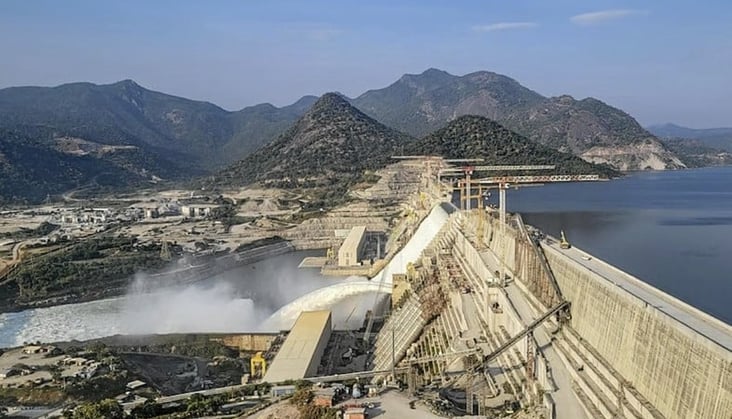
Ethiopia’s Prime Minister Abiy Ahmed has announced that the Grand Ethiopian Renaissance Dam (GERD), set to be inaugurated in September, will generate $1 billion annually for the country. The dam, Africa’s largest hydroelectric project, has been a point of pride for the prime minister, who is touting more big schemes.
“We expect $1bn every year from this dam,” Abiy said in a televised interview on state media, adding that the revenue “will be used for other projects”. The GERD, launched in 2011 at a cost of $4 billion, is expected to reach 5,000MW – roughly double Ethiopia’s current capacity. This massive project is a testament to the country’s commitment to harnessing its natural resources to drive economic growth and development.
The prime minister expressed confidence in completing the project and embarking on similar initiatives in the future. “We will do other projects like the GERD in the next five, 10 or 15 years,” he said. “We see that we can finish what we have started.” This ambitious plan is a reflection of the government’s vision for a prosperous and sustainable future for Ethiopia.
However, the project has stirred sharp tensions with neighboring countries, particularly Egypt and Sudan. Egypt, which relies on the Nile for 97% of its water needs, has invoked historic rights over the river and says the GERD is an “existential” threat. The Egyptian government has expressed concerns that the dam will significantly reduce the amount of water available for irrigation and other uses, potentially devastating the country’s agricultural sector.
“Many of our friends discussed, warned and threatened” Ethiopia over the GERD, including at the UN Security Council, Abiy recalled. “But if you look at the dams in Sudan and Egypt… they have not even lost a litre of water, and we do not want the GERD to cause them concern or fear.” The prime minister’s comments reflect the complex and sensitive nature of the issue, which has been the subject of intense diplomatic efforts and negotiations between Ethiopia, Egypt, and Sudan.
The GERD is expected to significantly impact Ethiopia’s energy landscape, with nearly half of the country’s population still living without electricity. According to the World Bank, as of January 2025, some 60 million of Ethiopia’s 130 million people lived without electricity. The dam’s revenue is expected to contribute to the country’s development and potentially improve access to electricity for its citizens. This could have a transformative impact on the lives of millions of Ethiopians, enabling them to power their homes, businesses, and industries, and driving economic growth and development.
As the GERD nears completion, it is clear that it will be a major milestone in Ethiopia’s development journey. The project’s success will depend on a range of factors, including the government’s ability to manage the dam’s impact on the environment and local communities, as well as its relationships with neighboring countries. Despite these challenges, the GERD represents a significant opportunity for Ethiopia to harness its natural resources and drive economic growth, and its completion is eagerly anticipated by the country’s leaders and citizens.