
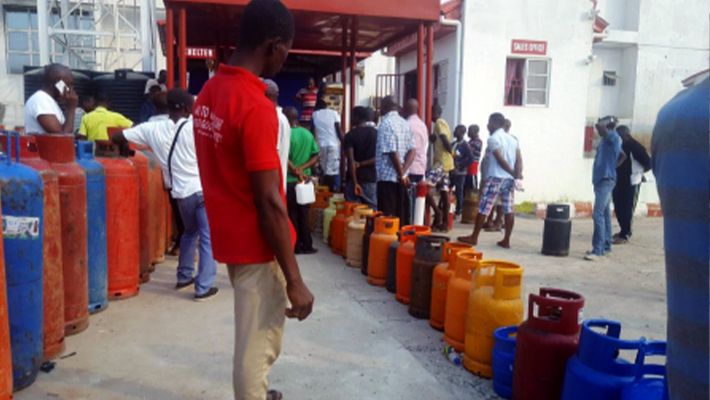
The Nigerian Midstream and Downstream Petroleum Regulatory Authority (NMDPRA) and Nigeria LNG Limited (NLNG) have pledged to increase domestic cooking gas supply and improve distribution to bring down prices and strengthen the country’s energy security.
The Chief Executive of NMDPRA, Rabiu A. Umar, disclosed this on Saturday during a visit to the NLNG plant and the ongoing Train 7 project site in Bonny.
Umar said expanding gas penetration, improving energy security and enhancing operational efficiency remained key priorities of the authority.
He explained that the objectives were in line with President Bola Tinubu’s agenda to promote gas utilisation, improve access to natural gas and expand gas infrastructure nationwide.
According to him, the authority is committed to ensuring sufficient supplies of cooking gas and natural gas, particularly in underserved communities, through infrastructure expansion and increased domestic production.
He identified the ongoing Ajaokuta-Kaduna-Kano (AKK) gas pipeline project as one of the initiatives aimed at extending gas infrastructure and making supplies available to more locations.
Umar disclosed that cooking gas prices had begun to drop by between N300 and N400 per kilogramme following increased supply and measures to tackle distribution challenges.
He attributed price fluctuations to demand and supply conditions, as well as logistical difficulties involving transportation, shipping and vessel availability.
The NMDPRA chief executive noted that although some of the gas consumed locally was produced within Nigeria, domestic supplies were also affected by international shipping challenges. He said the authority was engaging operators to resolve the problems.
He added that the meeting with NLNG was aimed at increasing the volume of cooking gas supplied to the domestic market, easing supply constraints and stabilising prices.
On whether cooking gas could sell below N1,000 per kilogramme, Umar said he could not guarantee a particular price because Nigeria operated a deregulated market.
However, he assured consumers that the regulator would ensure prices remained cost-reflective and intervene whenever pricing components exceeded acceptable limits to prevent exploitation.
He also called on NLNG to increase its production capacity by developing additional LNG trains, assuring the company of the authority’s support in providing a favourable regulatory environment.
Earlier, NLNG Managing Director and Chief Executive Officer, Adelaye Falade, said the company was working to expand gas production and domestic supplies of Liquefied Petroleum Gas (LPG) to improve availability and address market price distortions.
Falade said the company’s immediate priority was to operate its production facilities at full capacity but noted that insufficient feed gas supply had limited optimal plant utilisation.
He disclosed that NLNG had an installed production capacity of 22 million tonnes per annum (MTPA) across its six trains but had operated at approximately 80 per cent capacity so far in 2026.
According to him, this represented an improvement from the roughly 60 per cent capacity utilisation recorded over the previous two years.
Falade explained that the ongoing Train 7 project would add 7.5 MTPA to the company’s LNG production capacity, increasing its total installed capacity to approximately 30 MTPA.
He said the project would also raise NLNG’s domestic LPG supply capacity by 50 per cent, from the current 500,000 tonnes to about 750,000 tonnes annually.
He noted that the additional production would help close the gap between domestic LPG supply and national demand, thereby reducing Nigeria’s reliance on imported cooking gas.
Falade revealed that local production currently met about 40 per cent of the country’s LPG requirements, while imports accounted for the remaining 60 per cent.
He attributed rising prices and market distortions partly to the high cost of imported LPG, stressing that increased local production was necessary to achieve price stability.
The NLNG chief executive recalled that cooking gas sold for as much as N2,400 per kilogramme in some areas in June, despite the company’s loading price ranging between N800 and N900 per kilogramme.
He said increased domestic production, improved distribution and sustained cooperation with the regulator would help reduce the gap between loading and retail prices.
Falade also praised NMDPRA for addressing logistical challenges that had affected LPG discharge at NLNG’s terminal in Lagos, saying the interventions would allow the company to increase domestic supplies.
He described the engagement as historic, noting that effective regulation should go beyond enforcing compliance to creating an environment where businesses could operate and grow.
He expressed optimism that stronger cooperation between NLNG and NMDPRA would support industry expansion, encourage domestic gas utilisation and deliver greater benefits to Nigerians.
Also speaking, NLNG’s General Manager of Production, Nnamdi Anowi, highlighted the company’s achievements, including the loading of 6.485 LNG cargoes in November 2026 and the annual supply of 500,000 tonnes of LPG to the Nigerian market.
He also listed the operation of six LNG trains with a combined production capacity of 22 MTPA, 22 dedicated LNG and LPG vessels, an asset base valued at 22.9 billion dollars, revenue of $149.6 billion, dividends of $47.2 billion and tax payments of $10.8 billion among the company’s achievements.
Anowi identified vandalism, gas leakages and disruptions caused by repair works as some of the challenges facing the company.
He, however, highlighted NLNG’s contributions to sustainable development through investments in education, healthcare, employment and infrastructure.
He called for stronger collaboration between NLNG and NMDPRA to promote more effective operations and economic growth in Nigeria.
(NAN)