
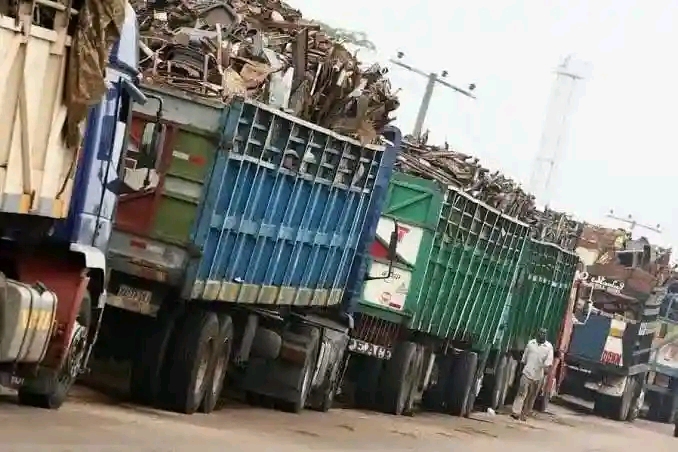
The Federal Government says it is strengthening regulations governing Nigeria’s scrap metal industry to prevent infrastructure vandalism, encourage responsible recycling and safeguard legitimate businesses.
The Head of Press and Public Relations of the Ministry of Steel Development, M.A. Tine-Iulun, disclosed this in a statement issued on Tuesday in Abuja.
According to the statement, the Minister of Steel Development, Shuaibu Audu, announced the move during the second phase of stakeholders’ engagement on the Draft Scrap Metal (Collection, Trading, Recycling and Regulation) Regulations held in Kano.
Audu, who was represented by the Director of the Steel and Non-ferrous Metals Department, Umar Tsoho, said proper regulation of the industry would boost steel production, create employment opportunities and promote sustainable industrial development.
Speaking on the theme, “Sustainable Scrap Metal Management through Effective Metallurgical Regulation: From Policy to Real Impact,” the minister described scrap metal as a vital resource for Nigeria’s industrial growth.
He stressed that an organised scrap metal value chain was essential to building a competitive steel industry, warning that inadequate regulation could lead to infrastructure vandalism and economic losses.
Audu explained that the proposed regulations would introduce licensing for operators, monitoring of collection centres, transaction tracking and enforcement of environmental and occupational safety standards.
He added that the framework would tackle the illegal purchase and sale of metals stolen from public infrastructure, industrial facilities and other protected assets.
The minister identified electrical cables, railway components and manhole covers as some of the public assets frequently targeted by vandals, noting that their theft disrupts essential services and increases maintenance costs.
He, however, clarified that the regulations were not designed to frustrate legitimate businesses or threaten the livelihoods of scrap metal collectors and traders.
According to him, the framework would introduce practical measures to formalise small-scale operators, while ensuring that larger recycling and processing facilities comply with relevant standards.
Audu said the Kano consultation followed the first phase held in Lagos from November 9 to 10, during which stakeholders reviewed provisions on licensing, operator classification, traceability, environmental protection and enforcement.
He assured participants that contributions from both engagements would be examined and harmonised to strengthen the proposed regulations.
Also speaking, the ministry’s Permanent Secretary, Amb. Nura Rimi, said the consultations were aimed at ensuring that the regulations reflected industry realities and addressed stakeholders’ concerns.
Rimi, represented by the Director of the Metallurgical Inspectorate and Environmental Protection Department, Christopher Wange, said the proposed framework would address existing gaps in licensing, traceability, safety standards and enforcement.
He urged stakeholders to submit practical recommendations on operator classification, security, environmental protection and collaboration among relevant agencies.
Similarly, the National Steel Council expressed support for the proposed regulations, describing them as essential to economic growth and job creation.
The council’s Acting Executive Secretary, Aminu Shehu, conveyed its position through the Head of the Planning, Research and Statistics Department, Nana-Firdausi Muhammad.
The Nigeria Security and Civil Defence Corps (NSCDC) also pledged to work with the ministry and other stakeholders to protect critical national infrastructure.
The Kano State Commandant, Mohammed Agalama, who represented the Commandant-General, Prof. Ahmed Audi, said effective regulation was necessary to prevent the theft of electrical installations, pipelines and railway facilities.