
By Ngozi Nwankwo
Civil Society Organizations, CSOs and Media have been engaged in promoting compliance with the provision of battery control regulations
National Environmental Standards and Regulations Enforcement Agency, NESREA and the Alliance for Responsible Battery Recycling,ARBR, had on Thursday in Abuja reminded CSOs and the Media their valuable role in addressing environmental pollution , also solicited their support in the areas of information dissemination and advocacy in enforcing compliance of battery regulation in the sector.
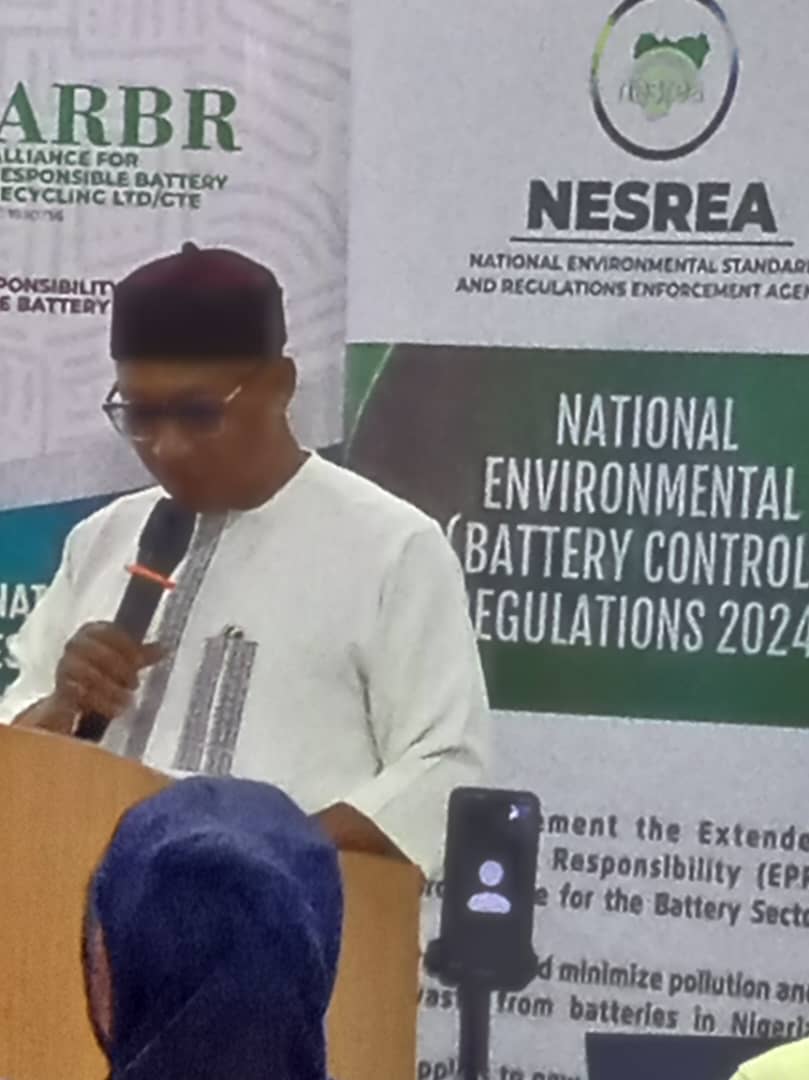
Speaking at the Interactive Session for the National Environmental (Battery Control) Regulations 2024, the Director General/ CEO, NESREA, Dr. Innocent B. Barikor said the National Battery Regulation is a comprehensive and an all-encompassing environmental tool for all sector stakeholders for the promotion of environmental sustainability in Nigeria.
Barikor said the improper handling of these batteries pose severe environmental and health challenges to the populace.
While saying the informal sector especially, which often handles waste batteries without proper formal regulation by way of governance, significantly contributes to environmental pollution, on the soil, air and water, Barikor pushed for more collaborative efforts of the Media and other stakeholders for an increased awareness on need for compliance of the battery control regulations.
The Interactive Session organised by NESREA, in Collaboration with the Alliance for Responsible Battery Recycling,ARBR, was to acquaint CSOs, Media and other stakeholders with this new very important legislation which would cause a paradigm shift from the old to the new in the Battery Sector, according to the NESREA boss.
” I therefore urge each and every one of us to avail ourselves the opportunity of assimilating the provisions of this legislation and be its Ambassadors to the wider regulated community towards its application and implementation to achieve voluntary compliance, as it is generally said, “to comply with the law is far cheaper than to violate”. And as my learned friends would also say, “ignorance of the law is not an excuse”, for it will no longer be business as usual in the Battery sector of the environment,” he said.
Although the contents of the implementation were yet to be uploaded on the NESREA’s Website, there are indications that the agency and other regulatory bodies like ARBR would go tough on users of battery and recyclers who violate regulations, as the agencies had warned that it would not be business as usual, that, “Ignorance of the law is not an excuse.”
Explaining the importance of the registration, the DG noted that
Regulation specifically tackles the challenges posed by informal recyclers and unregulated battery collection, recycling and disposal practices and seeks to formalize the battery recycling sector, promote safe disposal methods, minimize environmental pollution and promote the implementation of the Extended Producer Responsibility,EPR, programme for the battery sector in Nigeria.
“The EPR Programme mandates that producers take responsibility for the entire life cycle of their products as well as mandating producers, collectors and recyclers to work with the relevant Producer Responsibility Organization (PRO) i.e. the Alliance for Responsible Battery Recycling (ARBR) to ensure environmentally sound collection, transportation, storage and recycling of used batteries,” said Barikor.
Soliciting for the Development Partners’
continued assistance in the operationalisation and implementation of the Regulation to ensure that the essence trickles down to all stakeholders and the entire regulated community across the battery waste value chain, the CEO, therefore appreciated them for their unwavering support through the years, especially, Heinrich Boll Stiftung who put this whole event together.
It would be recalled that the Federal Government through NESREA, had Thursday last week, launched the National Environmental (Battery Control) Regulations, 2024 as an apparatus for environmental compliance monitoring and enforcement in the Battery Sector of the Nigeria economy, and to help address diverse environmental problems.
In her Goodwill Message, the Executive Secretary, ARBR, Mrs Miranda Amachree said the Regulations require every battery manufacturer, importer, distributor, retailer, including waste battery generators, collectors and recyclers to share in the cost and responsibility of managing waste batteries in Nigeria.
Amachree said regulation alone was not enough, adding that effective compliance with the regulations and monitoring depends on the active participation and cooperation of all stakeholders’ industry leaders, civil society organisations, government agencies, and the public.
In this regard, according to her, it is essential to create the necessary networks, partnerships, and collaborations to sensitize stakeholders to promote compliance with the provisions of the regulations.
“This strategy has been the overarching objective of ARBR’s advocacy program. ARBR has partners from Government, NGOs, and Development Partners to implement our objectives. In this wise, we will like to appreciate HBS for the sponsoring this event,” she said.
According to her, Batteries contain both valuable and hazardous materials, while harnessing the value, hazardous waste is discharged to pollute the environment and the health of workers if not properly managed.
“A lot of health issues are attributed to exposure to lead and other heavy metals such as cadmium and mercury contained in waste batteries.
“Heavy metal exposure has been linked to a range of health effects including neurological disorders, Cardiovascular disease (CVD), renal dysfunction, and carcinogenesis. Lead exposure are known to cause anaemia, hypertension, renal impairment, immunotoxicity and toxicity to the reproductive organs. The neurological and behavioural effects of lead are believed to be irreversible,” said Amachree.
She, therefore, said that with the Regulation in force, ARBR is further equipped with the necessary instrument to assist members to comply with the provisions of the regulations, expressing her optimism that its members could make a remarkable difference in improving environmental health and safety for a more sustainable and responsible future in the battery sector in Nigeria.