
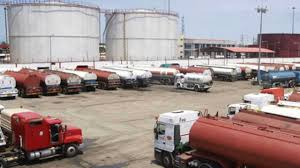
Oil marketers have expressed worry over the limited supply of Premium Motor Spirit, popularly called petrol, produced by the Dangote Petroleum Refinery.
Marketers who said that current 10 million litres being produced is contrast to the 25 million litres that the refinery had announced earlier it would release to the national oil company daily, saying the product is currently not enough to meet domestic demand.
In view of this, the oil marketers are to import the commodity to augment the supply from the $20bn Lekki-based plant, the marketers stated on Tuesday.
They aligned with the Trade Union Congress to demand that the refinery ramp up production, as some alleged that the plant was producing about 10 million litres of petrol daily, as against the 25 million litres that it earlier promised to produce.
Also Read:
Reps Urge Tinubu to Reverse Fuel, Cooking Gas Price Hike to Ease Burden on Nigerians
On September 15, when the refinery commenced the release of PMS to the domestic marketer, the Nigerian National Petroleum Company Limited announced that it (NNPCL) was to load 16.8 million litres of petrol from the Dangote refinery.
Also recall that on September 3, 2024, the Nigerian Midstream and Downstream Petroleum Regulatory Authority disclosed that the refinery would supply 25 million litres of petrol to the Nigerian market daily starting from September.
It added that this would rise to 30 million litres from September. In a short statement, the NMDPRA said it met with NNPC to agree on local crude supply to the refinery.
“At the NMDPRA headquarters in Abuja, NNPC reached an agreement to commence crude oil sale and supply to Dangote refinery in local currency.
“The refinery is now poised to supply an initial 25 million litres of PMS into the domestic market this September. And will subsequently increase this amount to 30 million litres daily from October 2024,” the NMDPRA stated on its X page at the time.
But oil marketers stated on Tuesday that the multi-billion dollar refinery was not producing up to that volume, as they aligned with the TUC to call on the plant to ramp up production or this would be sorted through the importation of PMS by dealers.
Speaking during a press briefing recently in Abuja, the National President, Trade Union Congress, Festus Osifo, said NNPC should source refined petrol from other places if the Dangote refinery could not meet the current daily demands of Nigerians.
“If it (petrol) is not available, it is a problem. If, for example, the production from Dangote Refinery is less than 15 million litres per day, it is not sufficient.
“So, while efforts are being made to ramp up production from Dangote refinery, what we are demanding is that we should look for every other means as we are ramping up production, we should source for that difference and bring it in for a while until Dangote can get to that level where the production is sufficient to get to all nooks and crannies of Nigeria.
“For us, that is key because it will address the issue of availability,” the TUC boss stated.
A major oil marketer claimed that Dangote’s refinery was producing about 10 million litres of petrol currently, whereas the most recent PMS consumption figure released by the NMDPRA indicated that Nigeria required about 40 million litres of the product daily.
“There is a lot of confusion in the industry. Even the Dangote refinery, the actual volume of PMS that comes out from there right now is not up to what it claims to be producing,” a major oil marketer, told The PUNCH.
“I reliably confirmed that they are not refining up to 10 million litres of PMS daily. And even for AGO (diesel), they don’t have enough volumes. We are in confusion right now in the downstream oil sector.
“And it may shock you to know that NNPCL does not have any vessel now that is coming, which could be used to augment what Dangote is producing. As we speak now, I don’t think they have vessels coming into the country with products. And this is because of the Dangote refinery but the refinery is not producing enough.”
The petrol marketer noted that the country would have started witnessing widespread queues had the cost of petrol been lower than the current price.
“We would have started seeing chaotic queues across the country but because the price of petrol and diesel is now so high, many people have decided to park their vehicles. The consumption has dropped drastically.
“The traffic situation on our roads reveals all this. The roads are now freer than they used to be in the past when petrol was subsidised. This is because the purchasing power is not there anymore. People now consider the cost of moving from one point to the other,” the source stated.
On his part, the National Vice President of the Independent Petroleum Marketers Association of Nigeria, Hammed Fashola, told one of our correspondents that the association would soon commence the importation of PMS.
He said this was why two tank farms were acquired by the group in Calabar and Lagos.
“We have acquired a tank farm in Calabar and another one in Lagos. We are positioning ourselves for the new era. We will not disclose the capacity of the tank farms now.
“We are free to start importation. With the new development, we are going to get our import licence soon, even as we are going to get a licence to buy from Dangote. So, it’s good to have two or three places to source your products from,” he said.
When asked why the association was planning importation at a time government was trying to stop it, Fashola retorted, “Once there is full deregulation, everybody’s free to bring in their products. And if the government doesn’t allow that, we will come back to square one.
“Monopoly will set in, which is not too good for Nigerians. You must have an alternative in life. When you don’t have an alternative, everything stands still.”
Speaking on the competitiveness of the price of imported PMS and locally-produced ones, he said the price of crude was the same globally.
“These locally produced petroleum products you are talking about, don’t forget that even the price of crude oil is still priced at the international rate. Don’t forget about that. So, we will look at it and the exchange rate, those are the two factors that determine the price. So, it depends,” he noted, adding that IPMAN had started working on the import license with the NMDPRA.
Meanwhile, another major marketer stated that no marketer had started lifting PMS directly from the Dangote refinery.
“Up till now, no marketer has lifted any PMS from Dangote. The major marketers are only lifting NNPCL’s allocation, just like when NNPCL imports the product and distributes it to them.
“That is the same way NNPCL allocated its product from Dangote to the major marketers. Even some members of IPMAN did off-take the product from NNPCL,” the dealer stated.
A Professor of Economics at the University of Ibadan, Adeola Adenikinju, said the discussion about whether or not marketers should be allowed to import PMS should be about the consumers, but stressed that there must be room for competition.
“At the end of the day, it is the consumers that we have to think about,” he said.
The don maintained that marketers would only opt for importation if the price offered by the local producer was higher or if the local producer did not have enough to satisfy them.
“Why is it that marketers want to import products? Is it that they find it cheaper? What is Dangote offering? If Dangote’s petrol product is cheaper than imported ones, the marketers would definitely purchase from him. So, is it that they find that it’s more expensive or some occurrences don’t make it possible for them to get it from Dangote?
“Marketers are profit-oriented people. If they find the terms of sales cheaper, I’m sure they will patronise Dangote,” the professor stated.
He added that there were insinuations that the quantity being produced at the moment was not up to daily consumption.
“If that is true, then, you know, again, at times we don’t even know how much our domestic consumption capacity is. In which case, you know, we must allow for competition – competition among domestic suppliers, competition between domestic suppliers and imported products.
“So, that competition will bring about efficiency and will reduce prices and consumers will benefit. Any time you don’t allow for competition, you simply allow producers to take advantage of the consumer,” he noted.
Meanwhile, about 335 trucks belonging to oil dealers associated with independent marketers have begun the process of loading petroleum products from NNPCL.