
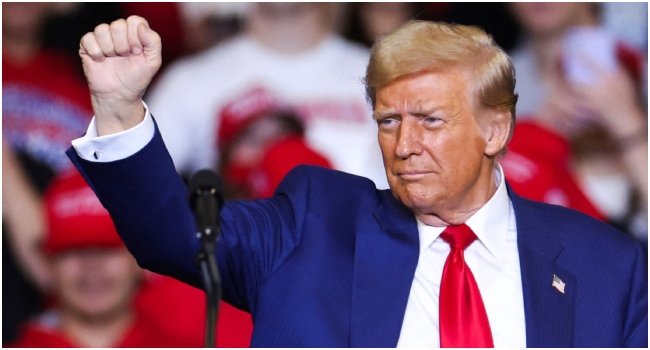
Donald Trump has declared victory in the 2024 United States presidential election, delivering a triumphant speech to a jubilant crowd of supporters in Florida.
The announcement marks a dramatic political comeback for the former president, who is now set to return to the White House after his defeat by Joe Biden in 2020. His victory has significant implications not only for the US but also for global politics, with echoes of similar electoral battles in African nations.
Trump’s proclamation came after a successful run in key battleground states including Pennsylvania, North Carolina, and Georgia, leaving his opponent Kamala Harris with limited options for a contested outcome.
The former president’s declaration sparked cheers from his supporters, who waved flags and chanted his name, reminiscent of political rallies in Africa where leaders rally their bases in similarly fervent displays of loyalty.
The victory was first projected by Fox News, with other networks slowly following suit. The media’s role in shaping the narrative surrounding the election outcome mirrors how media coverage often influences electoral results and public opinion in African nations.
Trump’s return to power signals a major shift in US politics. Many had speculated that his political career was over following his 2020 loss, but his ability to galvanize a broad base of voters has proven his political resilience. This reflects similar political comebacks seen in Africa, where leaders have managed to regain power after periods of setback.
In contrast, Kamala Harris, who ran on a platform of progress and inclusivity, did not address her supporters following the loss, as many appeared visibly disappointed. The mood shift between the two camps is a reminder of the emotional and often divisive nature of electoral outcomes, a dynamic frequently observed in African political contests.
On the legislative front, Republicans are projected to regain control of the US Senate, potentially shaping future policies on healthcare, the economy, and social justice. This shift mirrors the impact that changes in parliamentary control can have on governance in African countries, influencing both domestic policy and international relations.
Voter engagement during the 2024 election cycle was notably high, with millions participating in the political process. Issues such as economic reform, healthcare, and social justice dominated discussions, echoing similar concerns in many African elections, where economic stability and equality are key priorities for voters.
Trump’s campaign, centered on themes of American strength and nationalism, resonated strongly with his supporters, drawing parallels to the visions of progress and development promoted by many African leaders. Meanwhile, Harris’s focus on inclusivity and tackling systemic inequality struggled to garner widespread support, highlighting the challenge of building a coalition that appeals to diverse voter bases.
As the global community, including African nations, watches closely, the US election’s outcome is expected to influence international relations, particularly on issues like trade, security, and climate change. The political dynamics in the US will have a far-reaching impact on policy discussions worldwide, with implications for countries across the globe.
Looking ahead, discussions will likely focus on voter turnout, demographic trends, and shifting political alignments in both the US and beyond. Understanding these developments will be crucial for political parties worldwide, including those in Africa, as they prepare for future electoral contests.
The transition period ahead will be pivotal for Trump’s administration as he seeks to navigate a politically divided landscape. The prospect of bipartisan cooperation, or the lack thereof, will determine the success of his leadership. For now, all eyes remain on the unfolding political drama in the US, a situation that holds lessons for political leaders globally, particularly in Africa, where the dynamics of electoral politics often mirror those playing out in the United States.