
By ABAH ADAH, Abuja
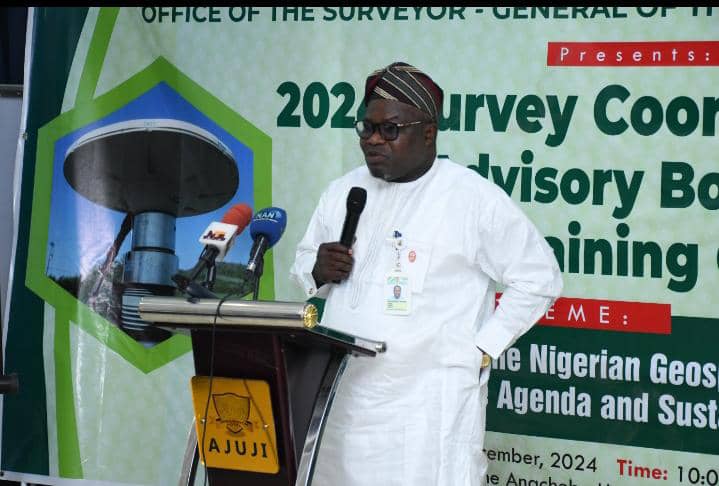
Surveyor General of the Federation of Nigeria Surv. Abuduganiyu Adeyemi Adebomehin has stressed the need to leverage geospatial data and technologies for national transformation, economic planning, and sustainable development.
The nation’s chief surveyor gave the advice in his welcome address at the 2024 Survey Coordination Conference and Advisory Board on Survey Training
held by the Office of the Surveyor General of the Federation (OSGoF) with the theme, “Repositioning the Nigerian Geospatial Space for the Renewed Hope Agenda and Sustainable Economic Growth,” in Abuja.
The event, according to a statement by Sani Datti, OSGoF’s head, Press and Public Relations, brought together 36 State and Federal Capital Territory Surveyor Generals, academics, and professionals to discuss ways to promote the geospatial and surveying industry in Nigeria.
The Surveyor General highlighted the need for capacity building, innovative training programs, and stronger partnerships to position Nigeria as a leader in geospatial technology and data management.
He said “I am confident that this conference will serve as a catalyst for repositioning our profession, revitalising the Geospatial sector, and ensuring that survey and mapping remain at the forefront of Nigeria’s developmental agenda.
“Our discussions and resolutions today will focus on strengthening survey across all levels, enhancing capacity building through robust training programmes, and fostering partnerships that advance Nigeria’s leadership in Geospatial technology and data management.”
In his keynote address, the President of the Nigerian Institution of Surveyors (NIS), Surv. Matthew Olomolatan Ibitoye, called for the urgent amendment of the outdated Survey Coordination Act to reflect current technological advancements and global best practices.
He commended the Office of the Surveyor-General of the Federation for organising the event and reaffirmed NIS’s commitment to advancing the surveying profession and supporting national development initiatives.
“It is essential to reflect on the Survey Coordination Act of 1962 and its subsequent amendment in 1968. This legislation placed the vital responsibility of coordinating survey activities across the nation and enforcing relevant regulations on the Office of the Surveyor General of Federation (OSGoF).
“However, the rapid advancements in surveying instruments, methods, and technologies have outpaced the provisions of this Act; it’s inability to accommodate these advancements has rendered it ineffective in certain critical areas,” the NIS president stated.
Earlier, the Director of Survey Coordination, Surv. Semiu Ayinde, highlighted the conference’s goals, which include discussing key challenges, opportunities, and strategies for effective Survey Coordination.
“Our goal is to enhance collaboration, improve data quality, and advance our collective mission, ” he stated.
According to the statement, the conference addressed critical challenges in the surveying sector, including technological gaps, outdated practices, and insufficient training and explored solutions to enhance the quality of geospatial data for effective decision-making.
The necessity of innovation, inclusiveness, and sustained investment in the geospatial space to meet the demands of the 21st century were underscored, while the resolutions adopted are expected to guide future policies and initiatives, reinforcing the critical role of survey and geospatial data in shaping Nigeria’s future.