
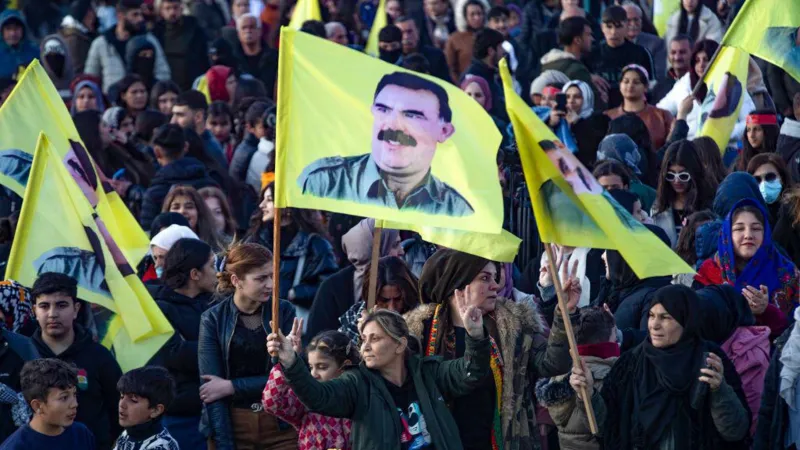
The outlawed Kurdish group PKK has declared a ceasefire with Turkey after its imprisoned leader, Abdullah Ocalan, urged the movement to lay down its arms and dissolve itself.
The announcement, made on Saturday, follows Ocalan’s recent appeal to end a four-decade-long insurgency that has claimed tens of thousands of lives in south-eastern Turkey. In response, the PKK stated that its forces would not engage in armed actions unless attacked. The group also expressed hope that Turkey would release Ocalan, who has been held in solitary confinement since 1999, so he could lead the disarmament process.
The call for peace comes months after Devlet Bahceli, leader of the ultra-nationalist MHP party and a key ally of President Recep Tayyip Erdogan, initiated efforts to resolve the conflict. Ocalan, affectionately known as “Apo” among Kurdish nationalists, met with members of a pro-Kurdish party this week on Imrali Island, where he is imprisoned.
In a letter read aloud by Kurdish politicians in both Kurdish and Turkish, Ocalan urged PKK members to lay down their weapons, stating that the group was initially formed because “democratic political channels were closed.” He acknowledged that the current political climate, shaped by Bahceli’s initiative and support from Erdogan, had created an opportunity for peace.
The ceasefire was met with cautious optimism among Kurdish leaders, and thousands gathered in cities like Diyarbakir and Van to watch the statement broadcasted on large screens. However, skepticism remains on both sides. Just last week, senior PKK commander Duran Kalkan accused Turkey’s ruling AKP party of seeking to “destroy and annihilate” the group rather than negotiate peace.
Meanwhile, Turkish-backed forces in north-eastern Syria have increased their military operations against Kurdish groups. The Turkish government has also continued its crackdown on pro-Kurdish politicians, with many arrested or imprisoned in recent years.
The PKK’s insurgency, which began in 1984, has long been a point of tension in Turkey, where Kurds make up about 20% of the population. While past ceasefires have collapsed—including a violent resurgence between 2015 and 2017—Ocalan’s call for disarmament signals another attempt at ending the long-running conflict.
Despite the declaration, uncertainty lingers over how Turkey will respond and whether the ceasefire will hold. The coming weeks will be crucial in determining whether this is the beginning of a lasting peace or just another temporary truce in a decades-old struggle.