
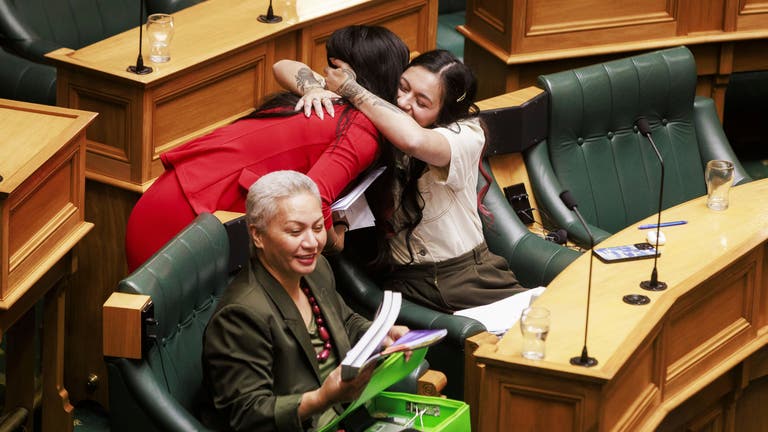
New Zealand lawmakers have voted down a controversial bill that aimed to rewrite the country’s founding agreement with Māori tribes, bringing an end to months of political tension and public outcry.
The bill was defeated in Parliament by 112 votes to 11 in Wellington on Thursday, a result met with loud cheers and a traditional Māori waiata sung by both lawmakers and onlookers.
The bill, known as the Principles of the Treaty of Waitangi, sought to legally define how the 1840 treaty between the British Crown and Māori chiefs should be interpreted today. Although it was unlikely to become law, the proposal stirred deep emotions nationwide and ignited fierce debates over Indigenous rights and identity. Last year, it also triggered New Zealand’s largest protest on race relations in decades.
The Treaty of Waitangi plays a central role in the country’s legal and political system. Signed in both English and Māori, the two versions differ in key areas, particularly over the level of authority Māori leaders agreed to give up. While both versions promised protection of Māori land and rights, disputes and breaches by the Crown led to long-term disadvantages for Māori, including loss of land, culture, and significant social inequalities.
The bill aimed to put fixed definitions into law for each section of the treaty, and argued that rights mentioned in the agreement should apply equally to all citizens, not just Māori. Its sponsor, David Seymour — a libertarian Māori lawmaker — said he believed the current legal approach offered special treatment based on race and needed to be changed. He called on other parties to support the bill, but none did.
Opposition leaders responded with strong criticism. Chris Hipkins, head of the Labour Party, described the bill as an attack on Indigenous rights and dismissed the idea that Māori enjoy privilege. He pointed to widespread inequities Māori communities continue to face, including higher rates of poverty and lower life expectancy.
Fellow opposition lawmaker Willie Jackson reinforced that the Treaty was never about racial favoritism but about honoring a legal agreement made between Māori and the Crown. He warned that the bill threatened decades of progress made in repairing the damage caused by colonization.
Public opinion strongly backed Parliament’s rejection of the proposal. The bill attracted a record-breaking 300,000 public submissions, with nearly 90% opposing it. Critics saw the bill as an attempt to erase hard-won Māori rights and undermine the partnership model the Treaty represents.
Māori lawmakers, including Hana-Rāwhiti Maipi-Clarke of Te Pāti Māori, celebrated the result as a major victory. Maipi-Clarke had previously made headlines for performing a haka and ripping up a copy of the bill in protest during its first reading last year — an act that landed her in hot water with parliamentary authorities.
Despite Thursday’s rejection, the bill’s survival past its first vote revealed the influence of New Zealand’s coalition politics. Prime Minister Christopher Luxon allowed it to progress earlier in a deal with Seymour that helped secure government formation. Though the bill is now officially dead, the episode has exposed lingering divisions over how the Treaty is interpreted and honored in modern New Zealand.
For now, the Treaty of Waitangi remains unchanged, continuing its role as the foundation of the country’s relationship with its Indigenous people — a relationship still shaped by the promises made more than 180 years ago.