
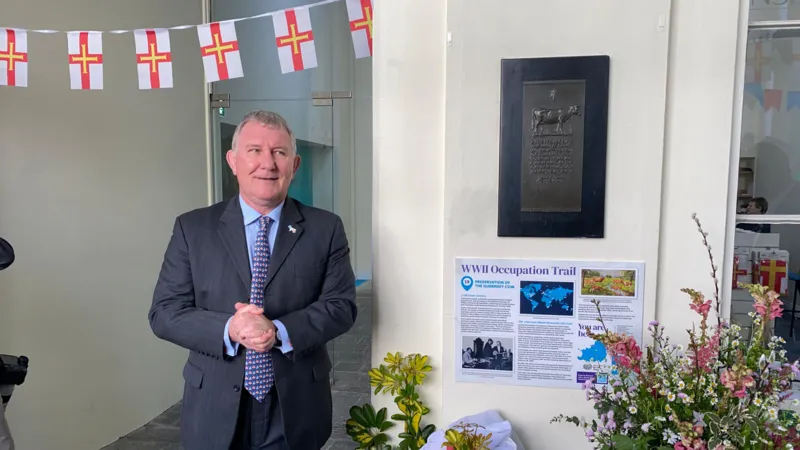
A commemorative plaque celebrating the introduction of Guernsey cattle to the United States in 1840 has been brought back into public view after years in storage during building renovations in Guernsey’s capital, St Peter Port.
The plaque, originally presented to Guernsey in 1960 by American admirers of the breed, had been hidden from public sight as the Market Buildings underwent structural work. Now reinstalled and officially unveiled by Lieutenant-Governor Richard Cripwell, it stands once again as a tribute to the agricultural bond between Guernsey and the United States.
An accompanying information board now explains the plaque’s historical importance, tracing the legacy of Guernsey cattle across the Atlantic. The marker not only recalls the breed’s journey to American soil, but also honours decades of agricultural cooperation.
The renewed display highlights a lesser-known chapter from World War II. During the German occupation of the Channel Islands, concern grew among American cattle breeders that the Guernsey herd could be wiped out. In response, the American (Island Memorial) Gift Fund was created, raising over $22,000—equivalent to nearly $315,000 today.
Although the Guernsey herd survived the war largely intact, the donation was used to establish a permanent home for the Royal Guernsey Agricultural and Horticultural Society. The gesture has remained a symbol of goodwill and support across generations.
Bill Luff, president of the society, described the plaque as a reminder of shared agricultural values and lasting international friendships. Historical records, including photos like one of a cow named Valentine’s Honour II exported to New Jersey in 1924, illustrate the depth of the connection.
Today, the Guernsey breed thrives across the United States, with an estimated 12,000 to 15,000 cows found in regions from Hawaii to Alaska. Robin Alden of the American Guernsey Association said interest in the breed remains strong, with farmers regularly reaching out in search of new stock.
With the plaque once again on display, the island not only celebrates its agricultural history but also reinforces its enduring ties with American farming communities.