
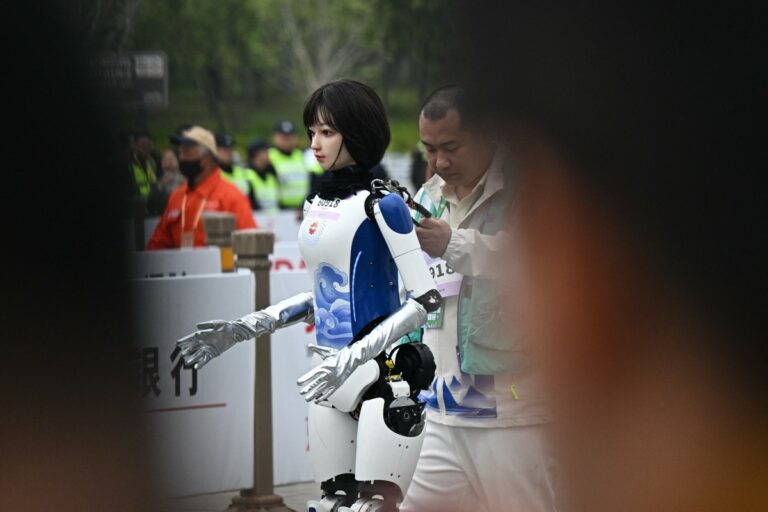
For the first time in history, humanoid robots joined thousands of people on the streets of Beijing to compete in a half marathon.
The event, held on Saturday in E-Town, a high-tech zone in the Chinese capital, brought together dozens of bipedal machines for a 21-kilometer race that aimed to push the boundaries of robotics.
The unusual race featured around 20 teams from across China, each entering robots that varied in size, shape, and style. Some machines stood just over two feet tall, while others reached nearly six feet and weighed close to 90 kilograms. The goal wasn’t to win, but to test how these machines handle real-world conditions over a long distance.
At the starting line, robots lined up as a Chinese pop song played on repeat. Some took off confidently, while others stumbled. One robot fell and lay motionless for minutes before slowly rising to applause. Another, resembling a Transformer, lost control and crashed into a barrier, knocking over an engineer in the process.
Despite these hiccups, the event was seen as a breakthrough. Engineers accompanied the robots along a separate track, monitoring performance and offering support when needed. Some robots operated independently, while others were controlled remotely.
The marathon wasn’t just a display of mechanical legs in motion—it was a real test of engineering. From battery life and motor strength to structural design and software reliability, the event gave developers a chance to see how their creations would perform outside the lab.
Engineers said preparing the robots took months. One robot had been trained by running a full half marathon every day, pacing at seven minutes per kilometer. While most teams hoped their machines would finish the race without major issues, many also brought backups just in case.
For young engineers like Cui Wenhao and Kong Yichang, the race was more than just a competition. It was a signal of where the industry is heading. They believe that as humanoid robots take on tasks humans perform, events like this help create a stronger foundation for integrating robots into everyday life.
China has made rapid progress in artificial intelligence and robotics, aiming to become a world leader in advanced tech. The half marathon follows other bold displays, like robot performances at national events and AI tools competing with American-made systems.
This half marathon may have been just a first step, but for the world of robotics, it marked a run toward a more integrated and automated future.