
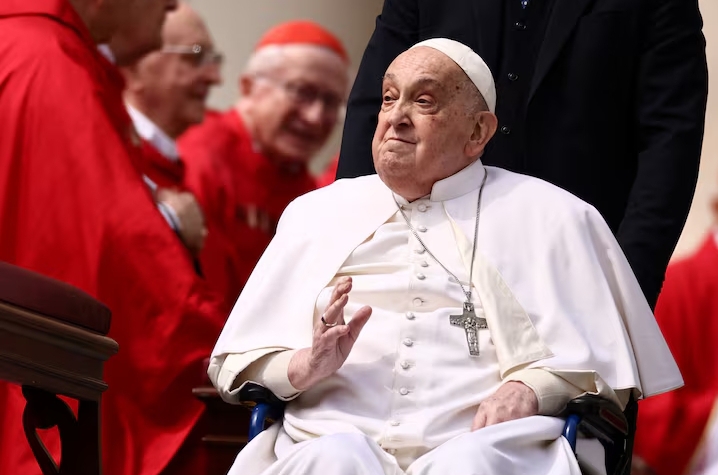
Pope Francis, the head of the Roman Catholic Church, has died at the age of 88, the Vatican announced on Easter Monday. He passed away at 7:35 a.m. at his residence in Casa Santa Marta, Vatican City, where he had been recovering from recent health complications.
The official declaration of his death was made by Cardinal Kevin Farrell, Camerlengo of the Apostolic Chamber, who addressed the faithful with a message of sorrow and remembrance. The late Pope had made a final public appearance just a day earlier, greeting crowds during the Easter Mass celebrations in St. Peter’s Square.
Born Jorge Mario Bergoglio in Buenos Aires, Argentina, Pope Francis became the 266th pontiff of the Catholic Church in 2013, following the resignation of Pope Benedict XVI. He was the first pope from Latin America, and the first Jesuit pope, widely known for his humility, reformist approach, and deep concern for the poor and marginalized.
In recent months, Pope Francis had been battling ongoing health issues. After being hospitalized for bronchitis in February 2025, he was later diagnosed with bilateral pneumonia. Though he was discharged from the hospital and returned to his Vatican residence, his health remained fragile. The Pope had a long history of respiratory problems, including the removal of part of his lung in his youth due to a severe infection. His declining condition had forced him to cancel several public events, including an important visit to the UAE in 2023.
Despite medical advice, Pope Francis continued to engage with the public whenever he could, demonstrating his dedication to his role. In one of his final acts, he approved a revised liturgical guide for papal funeral rites in April 2024. This new edition places greater focus on spiritual meaning rather than ceremonial grandeur, reflecting the Pope’s desire for simplicity and devotion in the face of death.
His funeral details have not yet been made public, but the updated guidelines are expected to shape the ceremony. The rites are designed to reflect the Pope’s wish to be remembered as a humble servant and a disciple of Christ, not as a figure of worldly power.
Pope Francis’ death marks the end of a transformative papacy that challenged tradition, prioritized compassion, and aimed to bring the Church closer to the people. His legacy will be remembered for decades to come by Catholics and non-Catholics alike.