
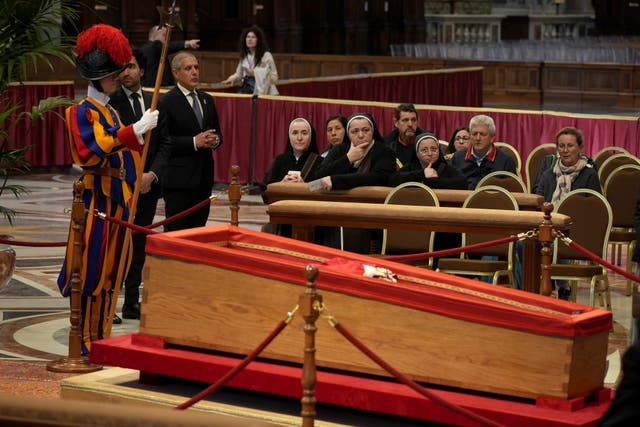
Thousands of people have continued to pour into St Peter’s Basilica to pay their respects to Pope Francis, whose body lies in state following his death at the age of 88.
But the somber atmosphere has been disturbed by a wave of public anger after mourners were seen taking selfies beside the pontiff’s open casket.
The Vatican opened the basilica for extended hours, even keeping it accessible nearly all night on Wednesday, to accommodate the massive crowds. Within the first 12 hours alone, over 50,000 people had filed past the late pope’s body. Many came to offer prayers, reflect quietly, or simply be present during a historic moment for the Catholic Church. But among the respectful visitors were others pulling out smartphones to capture selfies—a move that has upset many present and sparked criticism online and in the press.
Several mourners voiced disapproval, describing the photo-taking as inappropriate and offensive. Some expressed confusion over the lack of enforcement, especially after strict photo bans in sacred spaces like the Sistine Chapel. The mood for many shifted from reflection to disappointment, as individuals stood beside the casket grinning for their cameras rather than mourning in silence.
The Vatican, though aware of the issue, has limited options to control the behavior amid the massive influx of visitors. A Vatican source acknowledged the difficulty of policing the crowds but urged visitors to remember the solemn nature of the location and occasion.
The funeral for Pope Francis is scheduled for Saturday at 10 a.m. in St Peter’s Square. Heads of state, religious leaders, and thousands of faithful are expected to attend. Among those confirmed are the Prince of Wales, US President Donald Trump, French President Emmanuel Macron, UK Labour leader Sir Keir Starmer, and Ukrainian President Volodymyr Zelensky.
As the Church prepares for the final farewell, new personal details have emerged about the pope’s final days. According to his physician, Dr. Sergio Alfieri, Pope Francis’s last regret was missing the chance to perform the traditional foot-washing ceremony on Holy Thursday. Despite being frail, he had visited prisoners just days before his death—a visit that marked his final public appearance. The doctor recalled the pope’s quiet words: he was glad he saw them, but saddened that he was too weak to kneel and wash their feet as he had done in previous years.
With global leaders arriving and the Church mourning one of its most influential modern figures, the world turns to the Vatican once more—this time not for celebration, but for remembrance.