
Thousand of people filled the street of Nicosia last Friday to protest a new rule in Northern Cyprus schools that allows girls in high school to wear Islamic headscarves.
The demonstration comes as part of a larger reaction to Turkey’s growing influence over the Turkish Republic of Northern Cyprus (TRNC), a self-declared state recognized only by Turkey. The protest was one of the biggest seen in recent years, drawing broad support from civil groups, educators, and opposition parties.
The protest happened shortly after the TRNC government changed school rules in March. The change allows hijabs in high schools, while middle schools have the option to decide for themselves. This decision followed a social media uproar involving a student who was reportedly blocked from entering her school because she wore a hijab. The incident triggered widespread debate and set off a chain of events that led to the policy change and, eventually, to public anger.
The rule was introduced by authorities in the north of Cyprus, a territory backed politically and financially by Ankara. While the TRNC insists the decision is about student rights, many locals worry that such changes reflect Turkey’s broader effort to bring religion deeper into public life. This has unsettled many in a region where Islam is present but not often practiced in strict public forms, especially in schools.
People reacted with strong feelings. Educators, unions, and local organizations raised concerns about how religious symbols in schools might affect students. Many residents view the new rule as part of a pattern where Ankara is slowly reshaping TRNC society to match its own values. More than 100 civil society groups took part in organizing the march, which became a powerful display of frustration and unease.
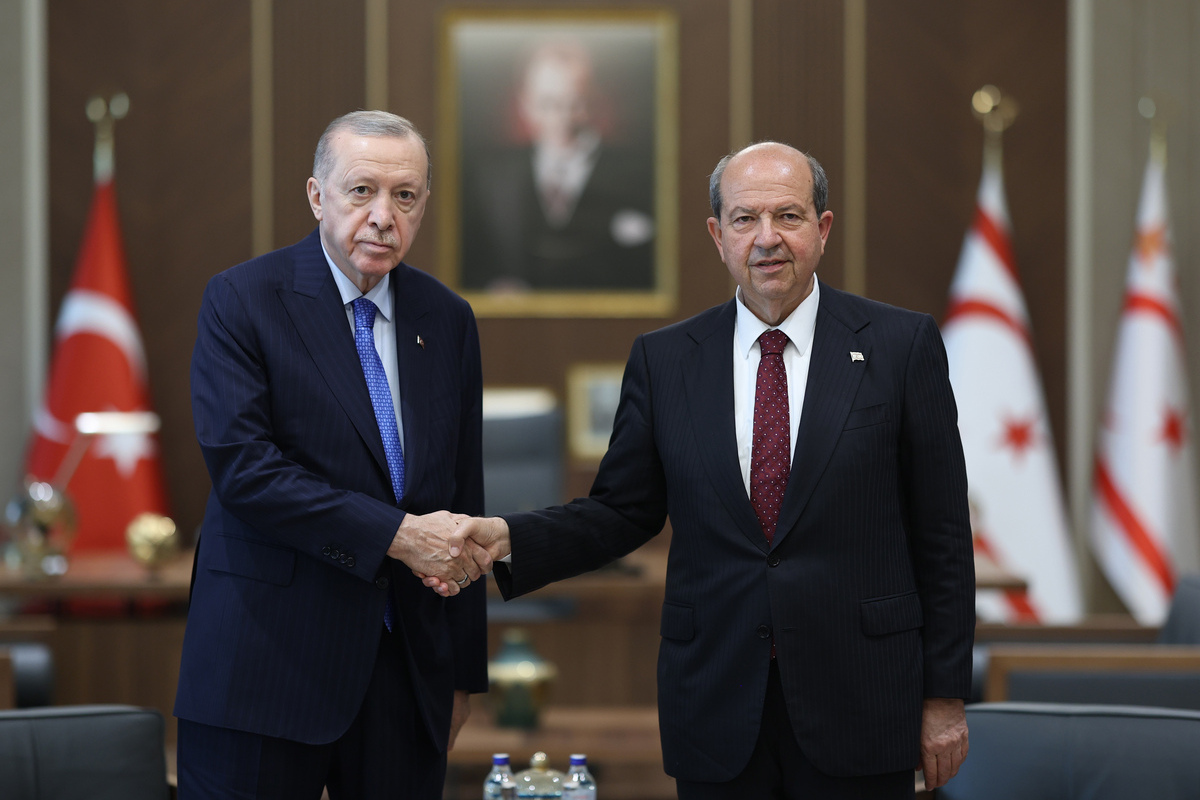
President Recep Tayyip Erdogan visited Northern Cyprus just as the protests reached their peak. His trip was meant to celebrate the opening of a new, expensive government complex funded by Turkey. However, the timing of his visit turned the spotlight on Turkey’s involvement in the TRNC, both politically and socially. Erdogan voiced strong support for the headscarf rule during his visit, making clear that Ankara stands behind the law.
This visit came only days after the killing of Cemil Onal in the Netherlands. Onal had ties to a controversial casino figure and had accused Turkish-linked officials of using Northern Cyprus as a base for illegal gambling and money laundering. His murder raised fresh concerns about political corruption, silencing of critics, and the reach of Turkish influence. What was supposed to be a routine visit by Erdogan turned into a moment of deep public concern over who really controls the future of the north.
As events unfold, people in the TRNC continue to wrestle with what direction their society is heading. The protests were not just about one school rule, but a broader statement from Turkish Cypriots who fear that their secular way of life is slowly being replaced by something they never voted for. The path ahead remains unclear, but the voices in the streets have made it known that many in the north are not ready to give up that fight.