
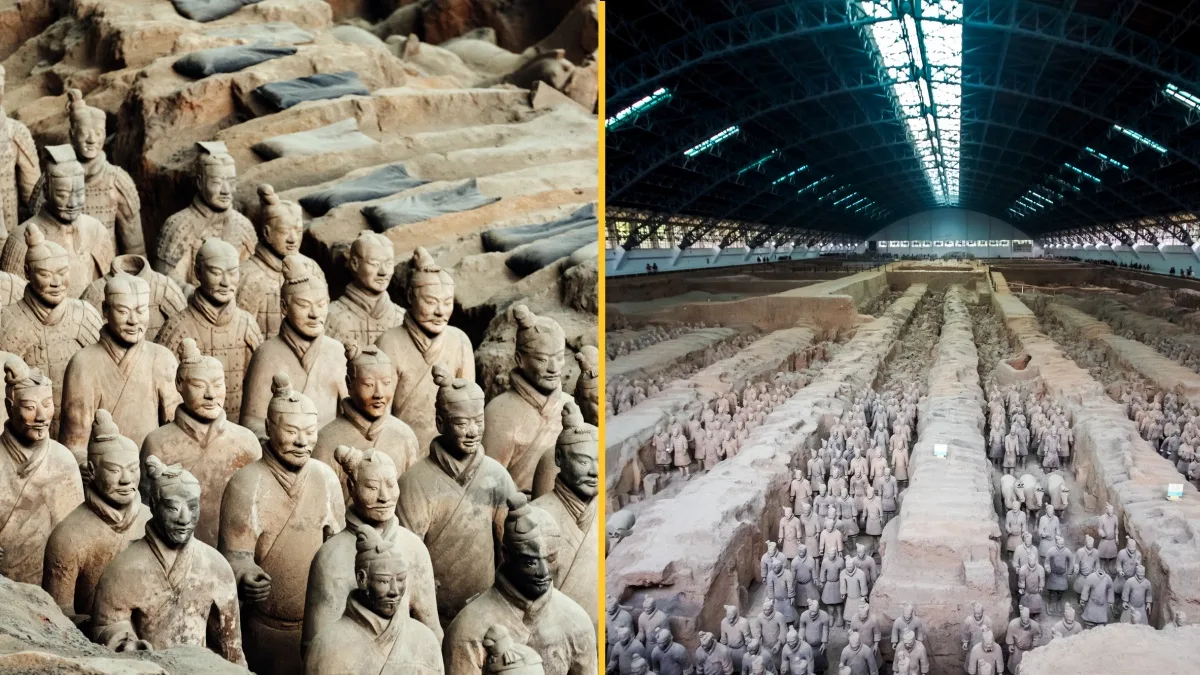
The burial site of China’s first emperor, Qin Shi Huang, remains one of the world’s most mysterious ancient wonders.
Despite being discovered decades ago, the central tomb has never been opened—largely due to fears that it could be rigged with lethal traps and filled with hazardous materials. More than two thousand years after his death in 210 BCE, the ruler continues to guard his final resting place, as archaeologists hesitate to uncover what lies within.
Located in central China, the tomb is part of a sprawling mausoleum complex near Xi’an, famously guarded by the Terracotta Army. These thousands of life-size clay soldiers, horses, and chariots were buried alongside the emperor to protect him in the afterlife. But while these statues have been excavated and studied, the main burial chamber beneath a large mound remains untouched.
The person buried there, Qin Shi Huang, was not only the founder of the Qin Dynasty but also the first emperor of a unified China. His reign saw major achievements such as the creation of the Great Wall and a vast network of roads. He also had a deep obsession with immortality, reportedly consuming mercury-based potions in pursuit of eternal life. Ironically, this might have contributed to his early death.
The tomb itself is believed to contain immense treasures and elaborate features. An ancient historian, writing a century after the emperor’s death, described palaces, flowing rivers of mercury, and even automatic crossbows set to fire at intruders. While this might sound like legend, modern researchers have found unusually high levels of mercury in the soil around the site, raising questions about whether these ancient claims may hold some truth.
The fear surrounding the tomb is not just about potential booby traps. Scientists and archaeologists worry that opening it without proper technology could destroy delicate artefacts, erase historical clues, or release toxic substances. The crossbows, if they exist and were made of metal, could theoretically still be functional. The tomb’s sealed environment has also been undisturbed for millennia, making it extremely fragile.
So far, all efforts to explore the tomb directly have been delayed. Though some scientists have suggested using advanced scanning methods to peek inside without opening it, such techniques have yet to be implemented on a large scale. Until then, the world can only wonder what secrets remain hidden underground.
As technology continues to improve, there may one day be a safe way to explore the tomb. But for now, the final resting place of Emperor Qin Shi Huang remains closed—protected by legend, mystery, and perhaps even ancient traps waiting in the dark.