
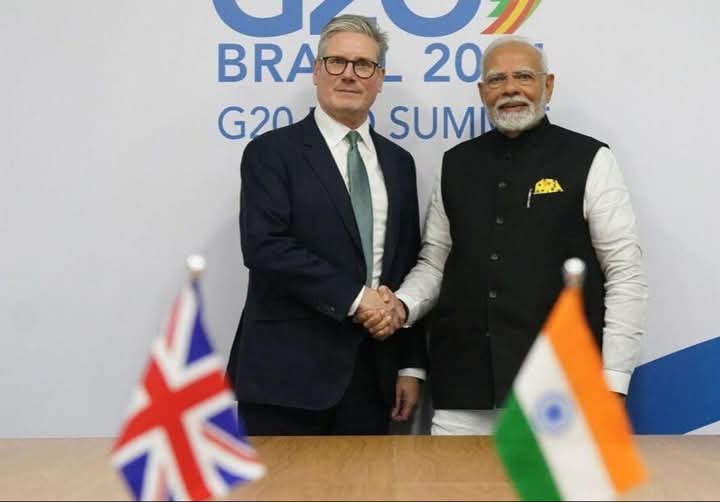
The UK and India have signed a landmark £4.8 billion trade deal, marking a significant milestone in the UK’s post-Brexit trade ambitions.
The agreement, which took three years to negotiate, will slash Indian tariffs on key UK products such as whisky, lamb and cosmetics, making it easier for British businesses to export to the booming Asian economy.
Prime Minister Keir Starmer hailed the deal as a “landmark deal with India, one of the fastest-growing economies in the world, which will grow the economy and deliver for British people and business”. Indian Prime Minister Narendra Modi described the agreement as “an historic milestone that is ambitious and mutually beneficial”, adding it would “catalyse trade, investment, growth, job creation, and innovation in both our economies”.
The deal will reduce tariffs on various UK products. For instance, tariffs on whisky and gin will be halved to 75% initially, with further reductions to 40% by year 10. Tariffs on lamb will drop from 33% to 0% upon entry into force. Additionally, tariffs on soft drinks will decrease from 33% to 0% after seven years, and tariffs on cosmetics will be reduced, making it easier for British companies to export to India.
In return, the UK will liberalize tariffs on Indian products, potentially leading to cheaper prices and more choice for British shoppers. Business Secretary Jonathan Reynolds said the benefits for UK businesses and consumers were “massive”, with wins across an array of sectors. “In times of global uncertainty, a pragmatic approach to global trade that provides businesses and consumers with stability is more important than ever,” he added.
Industry leaders have welcomed the deal, citing its potential to boost exports and create jobs. Mark Kent, CEO of the Scotch Whisky Association, said the reduction in tariffs would be “transformational for the industry”, potentially increasing scotch whisky exports to India by £1 billion over the next five years.
The trade deal is expected to increase bilateral trade by £25.5 billion a year by 2040 and boost UK GDP by £4.8 billion annually. With India forecast to become the world’s third-largest economy, this deal positions the UK for significant economic gains [1][2].