
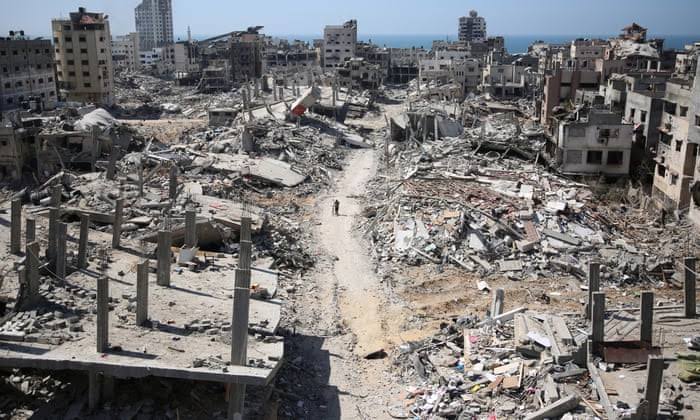
Since the collapse of the ceasefire, Israel has carried out large-scale demolitions across the Gaza Strip, destroying entire towns, neighborhoods, and infrastructure within a matter of weeks.
Satellite images have revealed widespread damage in areas claimed to be under Israeli military control, including the removal of buildings that were previously intact or only lightly damaged.
Controlled explosions have been used to bring down residential towers, schools, and public buildings.
Video evidence shows massive clouds of dust and debris as structures are levelled.
Much of the destruction appears to be planned rather than the result of active combat.
Some legal experts argue these actions could breach international law, particularly the Geneva Convention, which limits the destruction of property by an occupying power.
Israeli authorities, however, insist demolitions are conducted only when there is a direct military necessity and that all actions comply with international law.
In Rafah, near the Egyptian border, destruction has reached an extreme level.
What was once a city filled with homes, clinics, and schools has been largely cleared.
Damage assessments show that since April, this area has experienced some of the heaviest destruction in Gaza.
Plans have been announced to build a new “humanitarian city” in Rafah, where an estimated 600,000 Palestinians would be relocated.
The proposal has sparked criticism from various observers, who have compared the plan to a form of forced confinement.
Further reports point to a growing number of demolition jobs being posted online, where contractors are offered work in various parts of Gaza.
These job listings often name specific zones like the Philadelphi Corridor and Morag Axis, both under Israeli military control.
Since March, demolition activities have been identified in over 40 locations across Gaza.
In Tel al-Sultan, once a bustling neighborhood home to the region’s only maternity hospital and children’s care center, nearly every structure has now been destroyed.
Nearby areas such as the Saudi neighborhood have seen similar levels of clearance.
Other towns, including Khuza’a and Abasan al-Kabira — once thriving agricultural communities — have also been razed in a matter of weeks, reducing homes, farms, and civic buildings to rubble.