
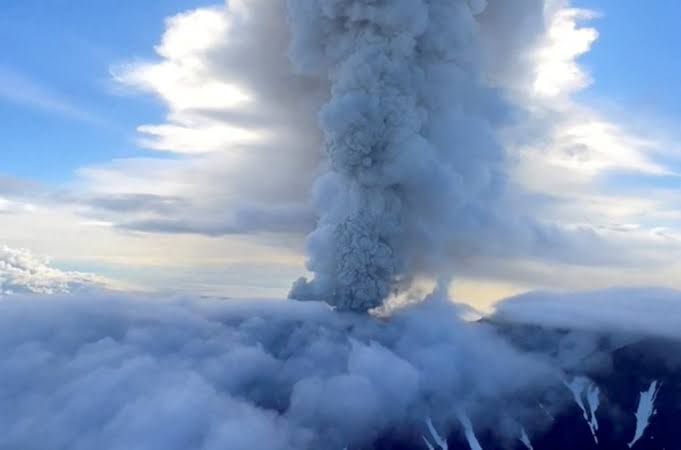
A volcano in Russia’s far eastern Kamchatka Peninsula has erupted for the first time in over five centuries, following a powerful earthquake that struck the region last week.
The Krasheninnikov Volcano sent an ash cloud rising up to six kilometers into the air overnight, according to Russia’s emergency services.
Officials confirmed that no nearby towns or villages are currently at risk.
However, the eruption came shortly before another earthquake hit the region, this time measuring 7.0 in magnitude and centered near the Kuril Islands.
This second quake prompted authorities to issue tsunami warnings for three coastal zones in Kamchatka, urging residents to stay away from the shoreline, even though wave heights were estimated at just 18 centimeters.
Experts believe both the volcanic eruption and the recent seismic activity may be linked to last week’s 8.8 magnitude earthquake—one of the strongest ever recorded in the region.
That quake triggered tsunami alerts across the Pacific, with warnings issued as far away as Chile and French Polynesia.
Millions of people were temporarily evacuated.
Olga Girina, head of the Kamchatka Volcanic Eruption Response Team, confirmed that Krasheninnikov last erupted in the 15th century and that the sudden activity might have been triggered by the earlier major quake.
The Kamchatka Peninsula sits along the Pacific Ring of Fire, an area known for frequent earthquakes and volcanic eruptions due to its active tectonic boundaries.
Despite its remoteness, the region is closely monitored by Russia’s scientific and emergency institutions due to its geological instability.
Images shared by the Russian news agency RIA showed the towering ash cloud rising from the volcano, captured from a helicopter above the site.
Scientists expect aftershocks and continued geological activity to persist for several weeks.