
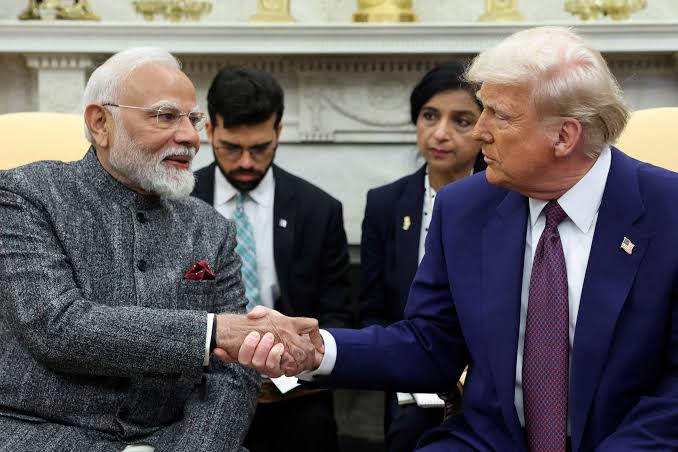
India has strongly opposed US President Donald Trump’s warning of higher tariffs over its continued import of Russian oil, calling the move “unjustified and unreasonable.”
The warning was posted on Trump’s Truth Social platform, where he criticised India for buying oil from Russia despite the ongoing war in Ukraine.
India is one of the largest buyers of Russian crude, and its demand has become increasingly important for Moscow after many European countries cut ties with Russian energy supplies in response to the 2022 invasion of Ukraine.
In his post, Trump accused India of profiting from cheap Russian oil and reselling it on global markets.
He promised to “substantially” raise tariffs on Indian imports into the US but did not detail the percentage increase.
This threat came just days after he imposed a 25% tariff on Indian goods.
India’s foreign ministry responded with a firm statement. Spokesperson Randhir Jaiswal said the US had earlier supported India’s purchase of Russian energy, aiming to support stability in global markets.
He also pointed out that the US continues to engage in trade with Russia, recording around $3.5 billion in goods exchanged last year despite its own sanctions.
The statement emphasized that India’s oil purchases were driven by market factors, not politics, and that Indian refineries, both private and public, make independent decisions based on supply security and cost efficiency.
Ajay Srivastava noted that the US had always been aware of these purchases and that the trade has remained transparent.
Trump’s shift in tone comes amid rising tensions in his foreign policy approach.
Although he has previously expressed a softer stance toward Russia, his recent language criticising President Vladimir Putin and threats of steep tariffs show a more confrontational approach.
He has demanded a ceasefire between Russia and Ukraine by August 8 or warned of additional penalties on Russian exports.
Despite pressure, Indian Prime Minister Narendra Modi has not ordered any halt in Russian oil imports.
Reports suggest Indian refineries will continue to make buying decisions based on their own commercial interests.