
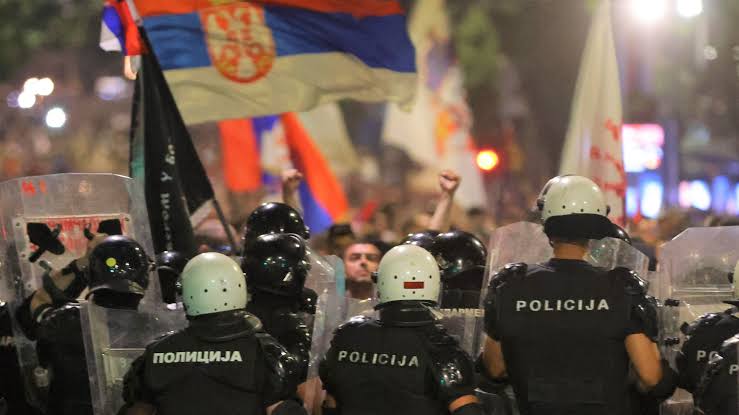
Police in Serbia used tear gas to disperse anti-government protesters on Thursday evening in Belgrade and Novi Sad.
In Novi Sad, demonstrators targeted the headquarters of President Aleksandar Vucic’s ruling Serbian Progressive Party (SNS), covering the building in red paint and breaking windows.
Reports indicated that neither police nor party supporters, who have guarded the building for months, were present when the protesters arrived.
Later, police in full riot gear cordoned off several blocks in central Novi Sad and deployed tear gas to push back the crowd.
In Belgrade, hundreds of protesters and SNS supporters clashed on one of the city’s main boulevards, throwing flares and firecrackers at each other.
Anti-government demonstrators attempted to reach SNS offices but were stopped by a heavy police presence.
Serbia’s interior ministry reported that at least five police officers were injured and 14 protesters arrested during Thursday’s clashes.
Violence has marked several days of protests across the country, with Interior Minister Ivica Dacic stating that demonstrations occurred at around 90 locations on Wednesday, resulting in nearly 50 arrests and injuries to roughly 80 civilians and 30 riot police.
The protests began in November 2024, led mainly by students, after the collapse of a railway station roof in Novi Sad killed 16 people.
The tragedy sparked outrage over corruption, and demonstrators are now calling for early elections. President Vucic, who has ruled Serbia for more than a decade as both prime minister and president, has faced criticism for authoritarian practices and widespread corruption.
Serbia ranks 105 out of 180 countries on Transparency International’s 2024 corruption perception index.
The European Union expressed concern over the violence. Officials noted that Serbia, as an EU candidate, must allow citizens to express their views freely and ensure journalists can report without threats.
UN human rights experts also warned of repeated repression, citing intimidation, arrests, and attacks on peaceful demonstrators.
The unrest reflects growing tension between pro- and anti-government groups in Serbia as the protests continue to gain momentum and authorities maintain a strong security response.