
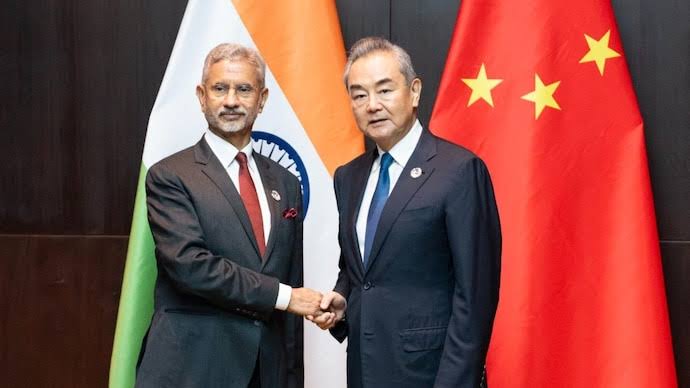
Chinese Foreign Minister Wang Yi arrived in New Delhi on August 18, 2025, for a two-day visit aimed at easing tensions between India and China.
He was welcomed at the airport by Gourangalal Das, Joint Secretary of the East Asia Division in the Ministry of External Affairs, before heading into a series of high-level meetings.
His trip comes at a time of global uncertainty and strained India–U.S. relations, placing extra weight on India’s ties with Beijing.
Wang met with External Affairs Minister S. Jaishankar soon after landing.
Jaishankar conveyed that the future of bilateral ties depends on maintaining calm along the Himalayan frontier, where thousands of troops remain deployed despite partial disengagement.
He stressed that both sides must ensure differences at the border do not escalate into disputes and reiterated that ties should rest on mutual respect, sensitivity, and shared interests.
The two ministers discussed implementation of earlier agreements on border patrols, troop pullbacks, and military-to-military communication.
Officials said the talks also reviewed trade recovery and the reopening of direct passenger flights between the two countries, measures seen as small but practical steps toward normalization.
Wang is also expected to meet National Security Adviser Ajit Doval under the Special Representatives mechanism, which has long served as the channel for managing the boundary issue.
Later in his visit, he is scheduled to call on Prime Minister Narendra Modi to prepare ground for Modi’s upcoming trip to China for the Shanghai Cooperation Organisation summit — his first visit to Beijing in seven years.
Beijing’s Foreign Ministry framed Wang’s India trip as an opportunity to strengthen political trust, deepen cooperation, and stabilize relations after years of turbulence since the 2020 border clashes in Ladakh.
Analysts believe the timing is notable: with U.S.–India trade disputes flaring and Washington increasing tariffs, New Delhi may be recalibrating its regional posture by re-engaging with China.
Observers point out that the trip signals cautious optimism. While neither side expects a quick breakthrough on the border, the revival of dialogue and plans for Modi–Xi talks suggest a renewed effort to manage differences while seeking common ground on economic and regional issues.