
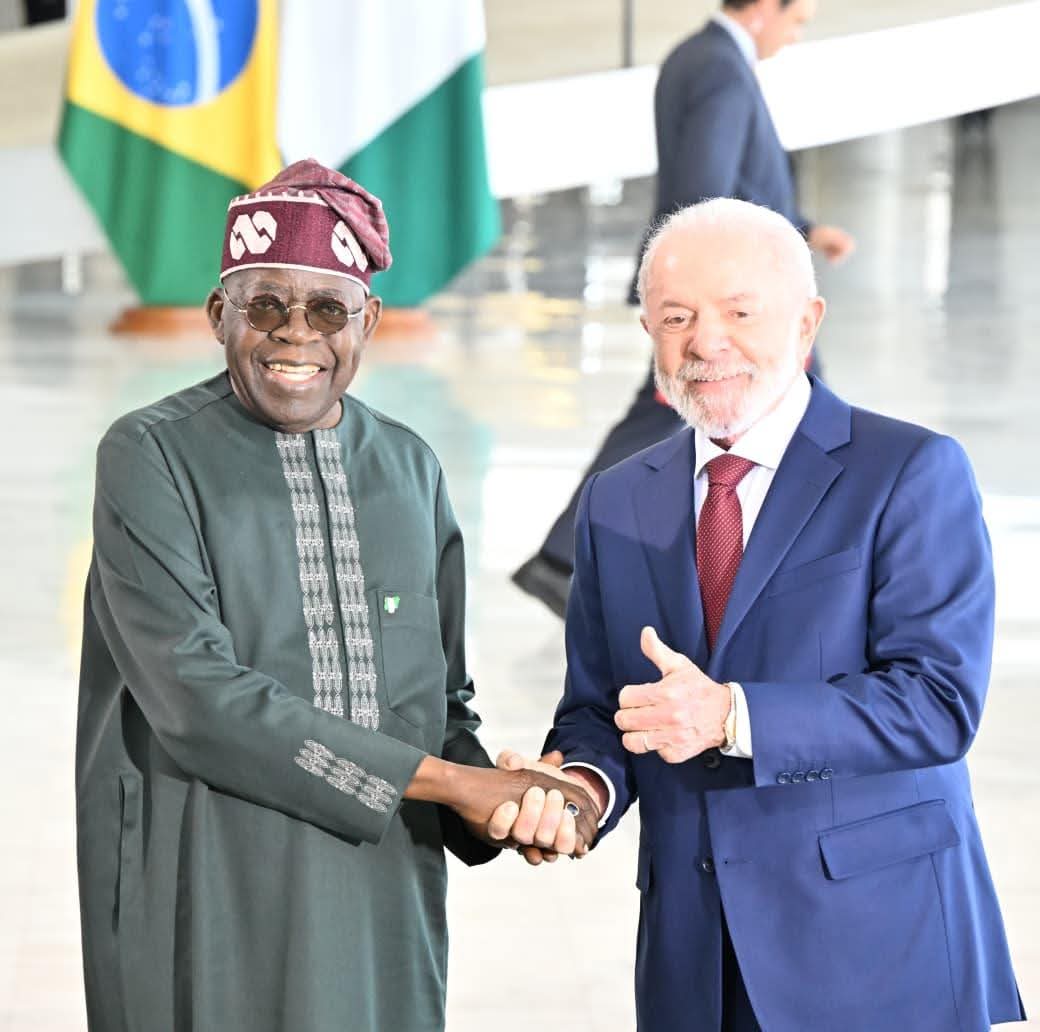
Nigeria and Brazil have signed five Memoranda of Understanding (MoUs) to strengthen trade, diplomacy, science, aviation, and finance cooperation. The agreements were signed during President Bola Tinubu’s state visit to Brazil, where he met with Brazilian President Luiz Inácio Lula da Silva.
President Tinubu welcomed Petrobras’ imminent return to Nigeria, five years after Brazil’s state-owned oil company halted its joint venture operations. “We have the largest gas repository. So I don’t see why Petrobras doesn’t join as a partner in Nigeria as soon as possible,” he said, adding that he appreciated President Lula’s promise that this would be done as soon as possible.
The President praised President Lula’s commitment to revitalizing the partnership between the two countries, noting that Nigeria’s economic space remains a virgin land, full of opportunities for Brazilian companies. He acknowledged Embraer’s efforts in addressing the critical challenges of local airline operations in Nigeria, primarily through establishing a Service Centre to serve as a hub for the subregion in essential repairs and maintenance of its ever-increasing fleet in Nigeria.
President Tinubu emphasized the urgency of moving beyond symbolic ties to concrete economic cooperation. “Honourable Ministers of both countries, members of the Brazil Business Group, I have listened carefully to my friend, President Lula. We had a lengthy discussion. We talked about history and about African and Brazilian heritage,” he said. “We tried to see why we are not at the level we wanted. We have the most populous, the most dynamic country, Nigeria, share with Brazil. We need to share—technology transfer, energy, economy—so that Brazil can continue to widen the opportunities for us to embrace Africa. Africa is the new frontier.”
The President highlighted areas of cooperation, including technology transfer, food security, manufacturing, and renewable energy. “There is no other way to do it than to embrace it with technology, fast development, research, food sovereignty, and manufacturing,” he said. He also stressed the need for investment and knowledge exchange on healthcare and pharmaceuticals.
“We have elevated this promise to the path of reality, as you have seen in various MOUs. I don’t know why the manufacturing of generic drugs, which Brazil has done deeply and far, cannot be in Nigeria,” he said. “I don’t see why the technological superiority of Brazil is not shared with Africa. We assured each other that only we can develop our economies to help our sovereignty.”
President Lula welcomed the restart of the Brazil-Nigeria relationship, saying, “At a time when protectionism and unilateralism have returned, Nigeria and Brazil reaffirm their bet on free trade and productive integration.” He also spoke on the BASA agreement, stating that increasing direct connections between Nigeria and Brazil is essential to strengthen ties between their societies.
The two leaders witnessed the signing of agreements and MOUs at the Palácio do Planalto in Brasília. Nigeria is Brazil’s 49th largest export destination, with trade totaling nearly US$2.1 billion in 2024. Brazil exported almost US$1 billion to Nigeria, primarily sugar and jams, and imported US$1.1 billion, mostly fertilizers.
President Tinubu assured investors that Nigeria’s economic reforms are yielding results, saying, “The reforms I’ve embarked upon since I took over in Nigeria have been very impactful. It was initially painful, but today the result is blossoming.” He added that the reforms have made it easier for businesses to operate in Nigeria, with the door open for foreign exchange and no more corruption.