
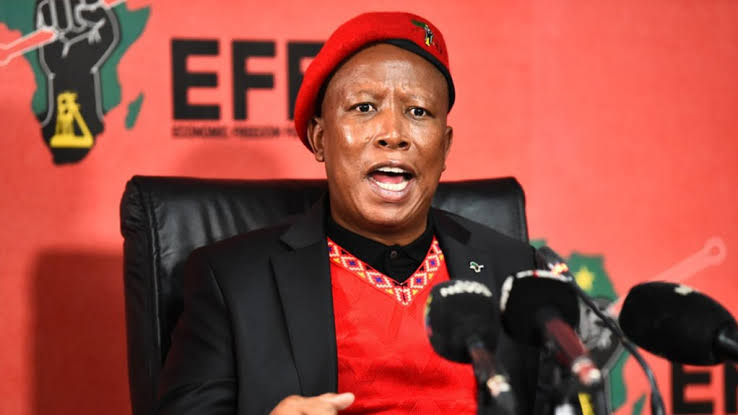
South Africa’s Equality Court has delivered a ruling against opposition leader Julius Malema, finding him guilty of hate speech over remarks made during a political rally in 2022.
The judgment, issued on August 27, 2025, concluded that Malema’s statements went beyond political rhetoric and constituted incitement to violence based on race.
The case stemmed from a gathering organized by Malema’s Economic Freedom Fighters (EFF), where he told supporters not to be afraid to kill in pursuit of revolutionary change.
His words referenced confrontations involving white South Africans, which the court determined created a direct link between race and calls to violence.
The judge ruled that such speech was in clear violation of the Promotion of Equality and Prevention of Unfair Discrimination Act, which prohibits communication that promotes hatred or incites harm.
The South African Human Rights Commission (SAHRC) filed the complaint, arguing that Malema’s language placed communities at risk and undermined the country’s constitutional protections.
The Equality Court agreed, stating that freedom of expression could not be used as a shield for statements that directly endanger others.
This is not the first time Malema has faced legal consequences for his speech. In previous years, he was brought to court over his use of struggle songs containing violent lyrics and for remarks judged to be racially inflammatory.
Some of those rulings were overturned on appeal, but critics argue his repeated run-ins with hate speech laws reflect a pattern of disregard for boundaries between political expression and incitement.
The verdict has drawn sharp reactions across South Africa. Supporters of Malema dismissed the ruling as politically motivated, while civil society groups welcomed it as a necessary step in protecting social stability.
The ruling does not automatically impose criminal penalties, but the court can order remedies such as fines, compensation to affected parties, or a public apology.
There is also the possibility that the matter could escalate to criminal prosecution if state authorities choose to pursue it further.
Malema, a prominent and polarizing figure in South African politics, has long positioned himself as a radical voice for economic justice and land reform.
However, his critics argue that his rhetoric often fuels division at a time when the country continues to struggle with inequality and racial tensions.
The ruling underscores the ongoing challenge South Africa faces in balancing robust political debate with the need to safeguard communities against harmful speech.
Malema is expected to appeal the decision, setting the stage for another legal battle that could further shape the country’s evolving jurisprudence on freedom of expression.