
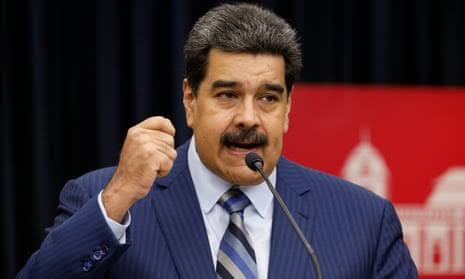
Venezuelan President Nicolás Maduro has accused the United States of posing the “biggest threat in 100 years” to the country and the wider region following the deployment of U.S. naval ships to the southern Caribbean.
The U.S. says the deployment is part of an anti-drug trafficking operation, but Maduro claims it represents a direct challenge to Venezuela’s sovereignty.
The U.S. Navy and Coast Guard ships, including guided-missile destroyers and a nuclear-powered submarine, have significantly increased their presence in the southern Caribbean.
Maduro warned that if Venezuela were attacked, he would constitutionally declare a “republic in arms” and has ordered the mobilization of troops and civilian militias to protect the nation.
The Venezuelan president also accused the U.S. of attempting regime change and described the naval buildup as an “extravagant, unjustifiable, immoral, and absolutely criminal threat.”
Relations between the two countries remain tense, as the U.S. has refused to recognize Maduro’s last two election victories and has accused him of leading a drug cartel, even offering a $50 million bounty for his capture.
Meanwhile, neighboring Guyana has welcomed the U.S. military presence, viewing it as a measure to protect regional security.
The countries have long been in dispute over the oil-rich Essequibo region, which makes up two-thirds of Guyana’s territory.
Recently, Guyana accused Venezuelan forces of firing on a boat carrying election materials in the contested area, an allegation that Venezuela denied, claiming that Guyana was attempting to provoke conflict.
International observers are closely monitoring the escalating situation, concerned about the potential for increased instability in the Caribbean and South America.
Analysts suggest that the U.S. naval presence may also serve as a form of “gunboat diplomacy” aimed at pressuring the Maduro government, even as Washington maintains it is focused on counter-narcotics operations.