
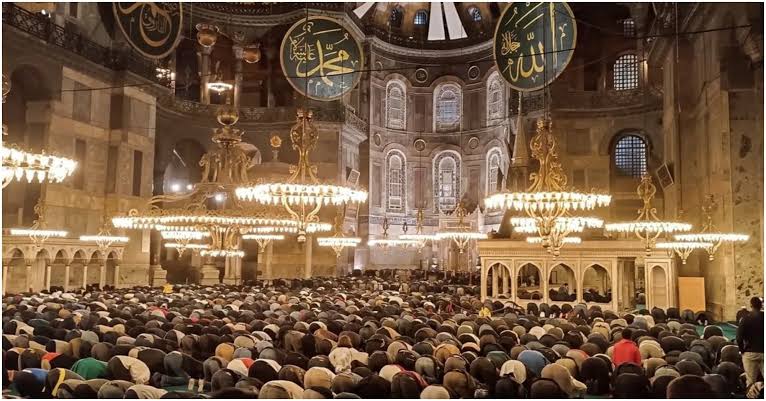
Muslims across the globe marked the birthday of Prophet Muhammad this week with prayers, processions, and cultural traditions that united communities in devotion.
Known as Mawlid al-Nabi, the holiday is observed on the 12th day of Rabi’ al-Awwal in the Islamic calendar and remains a public holiday in many Muslim-majority nations.
In Yemen’s capital, Sana’a, tens of thousands joined a mass gathering organized by the Houthi movement, filling streets with chants and green banners.
In northern Iraq, crowds assembled in Irbil, where the historic citadel became a backdrop for drums, poetry, and worship.
Celebrations stretched from the Middle East to Africa and Asia. In Mogadishu, Somalia, people filled the streets with processions and devotional music, reviving practices once restricted by extremist rule.
In Turkey, Istanbul hosted large gatherings with Quran recitations and traditional chants.
Morocco’s city of Salé carried forward its centuries-old “Candles Convoy,” while in Algeria’s Sahara, the week-long “Sbooa” pilgrimage honored local saints.
In Southeast Asia, countries like Indonesia and Malaysia marked the occasion with parades, gamelan music, and communal feasts.
Communities also emphasized charity, with food distribution and acts of kindness at the heart of observances.
Though widely celebrated, Mawlid has been debated among Islamic scholars for centuries. Some conservative groups reject the practice as an innovation, while the majority embrace it as a way to honor the Prophet’s life and teachings.
The holiday, which this year fell between September 4 and 5, is seen by many as a time of reflection, remembrance, and unity.
Across regions, the celebrations showed both spiritual reverence and cultural diversity, reinforcing Mawlid’s role as one of the most cherished occasions in the Islamic calendar.