
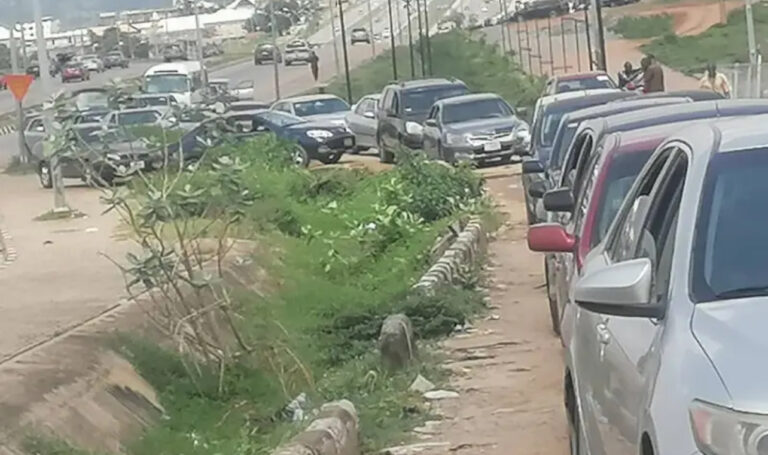
As more motorists key into Compressed Natural Gas (CNG) to run their vehicles, the search for the product has become frustrating, given the inadequate infrastructure by marketers.
A correspondent who went around Abuja reports that motorists were seen queuing for endless hours for CNG.
The introduction of CNG is about chasing a cleaner, cheaper, and sustainable energy path, but Nigerians have raised concerns that the rapid expansion of CNG infrastructure should have been envisaged.
Some motorists who spoke to journalists blamed the marketers for not putting enough infrastructure in place to dispense CNG, urging the government to mandate them to do so.
One of the motorists, Olakunle Ajayi, said he was in the queue for six hours before he could buy, adding that he joined the queue around 9:00 a.m. at the NNPC Zone 1 retail outlet and was able to get a refill around 3:00 p.m.
“Something should be done urgently; otherwise, this initiative will be dead before the end of the year,” he said.
Sylvester Abua, another motorist, said he was an ardent user of CNG due to its benefits of being a cleaner energy, low combustion rate, and affordability. However, he regretted the current challenge, which was gradually eroding its advantages.
“The government should help us to get more supply by allowing people who are willing to invest through granting of waivers for more marketers to come on board.
“I also want the government to ensure that it sets up a mechanism to monitor the sales and prices by the retailers to the end users. This will regulate their activities, excesses, and foster guidelines to operate,” he said.
Another motorist, who only gave his name as Ehis, said it was difficult to comprehend that there was an increase in price two weeks ago, yet the product was still difficult to get.
“Initially, we bought at N230 for one standard cubic metre (SCM), but it was increased to N380 for one SCM; that is, an additional N150.
“So, why is it still difficult to get that we will have to queue for hours before we can buy?” he asked.
Mr Ehis called on the government and the CNG marketers to use the opportunity of the increase in price to spread infrastructure to ease the suffering of motorists who saw the product as an alternative fuel.
Ezekiel Manah, who expressed disappointment over the situation and decried the acute scarcity of CNG filling stations, said the aim of converting his car was defeated because of the paucity of refilling stations in the FCT and beyond.
A CNG marketer said his colleagues are finding it difficult to invest in the sector due to low profit margins.
According to the marketer, some of them started the business, but immediately discovered that N230 being charged per standard cubic metre before was not profitable; they stopped, because they didn’t want to run at a loss.
However, the Presidential Compressed Natural Gas Initiative (PCNGI) had emphasised that Nigeria is making progress in expanding the CNG infrastructure and investments across the country, adding that engineering feats take time.
Michael Oluwagbemi, the programme rector of P-CNGI, had said that with 100,000 vehicle count, the queues at CNG stations were naturally going to increase, because of such unprecedented increase (a fivefold increase in just one year)
Mr Oluwagbemi said this resulted from massive incentives provided by the administration and the breakthrough in awareness due to the economic benefits of the switch.
According to him, the government’s resolve and private ambition must meet in partnership to expand filling points far and wide, turning sparse oases into a lush landscape where CNG flows freely in a new era of sustainable motion.
The recent landmark deployment by Dangote Group, featuring 4,000 CNG-powered trucks, 100 virtual pipeline vehicles, and multiple daughter stations, is just one high-profile testament to the Initiative’s impact.
(NAN)