
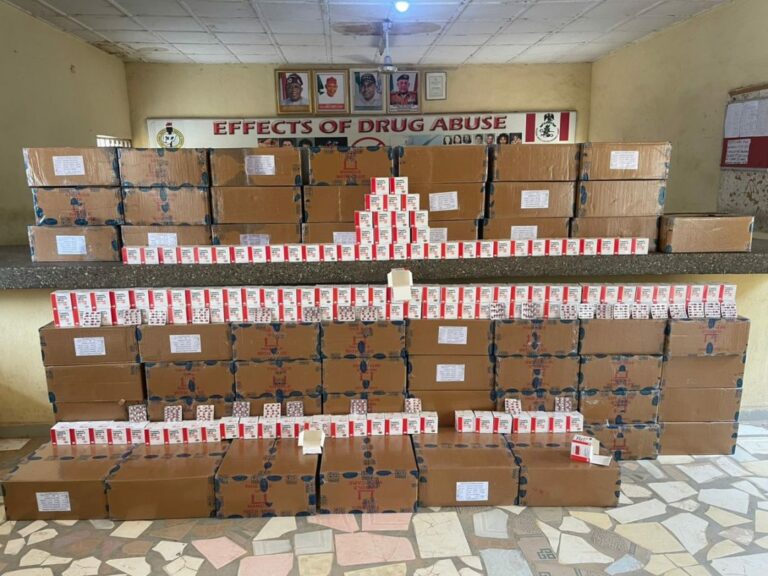
The National Drug Law Enforcement Agency, NDLEA, has handed over 450,000 pregabalin capsules seized in Kano to the National Agency for Food and Drug Administration and Control, NAFDAC, for forensic checks and regulatory action.
The consignment, packed in 60 cartons and hidden in a van, was intercepted by an NDLEA patrol team along the Kano–Hadejia road. According to officials, no documents or proof of legitimate ownership were provided when the drugs were brought to the command’s office for investigation.
Pregabalin, a medication prescribed for epilepsy, anxiety, and nerve-related pain, has in recent years become one of the most abused drugs in Nigeria. It is often diverted into the black market, where it is taken in high doses for sedative and euphoric effects. The misuse of the drug has been linked to rising cases of addiction and mental health problems, especially among young people in northern Nigeria.
The transfer of the seized capsules followed the agreement signed in November 2024 between NDLEA and NAFDAC to strengthen intelligence sharing, forensic testing, and enforcement measures against pharmaceutical trafficking. NDLEA’s Chairman, Brig.-Gen. Mohamed Buba Marwa (rtd), directed the immediate handover in line with the agency’s collaborative framework with NAFDAC.
The NDLEA Kano State Command, led by ACGN A.I. Ahmad, said the action reflects ongoing cooperation between the two agencies to prevent controlled medicines from being diverted into illegal markets. On receiving the consignment, NAFDAC officials assured of full collaboration in the next stage of investigations.
The NDLEA has repeatedly warned about the trafficking of pregabalin, tramadol, codeine, and similar substances, noting that their abuse continues to threaten public health and safety. To counter this, the agency has increased patrols and surveillance along major transport routes used by traffickers.
The interception of nearly half a million pregabalin capsules in Kano marks one of the major steps taken under the new NDLEA–NAFDAC partnership aimed at tightening control over pharmaceutical distribution.