
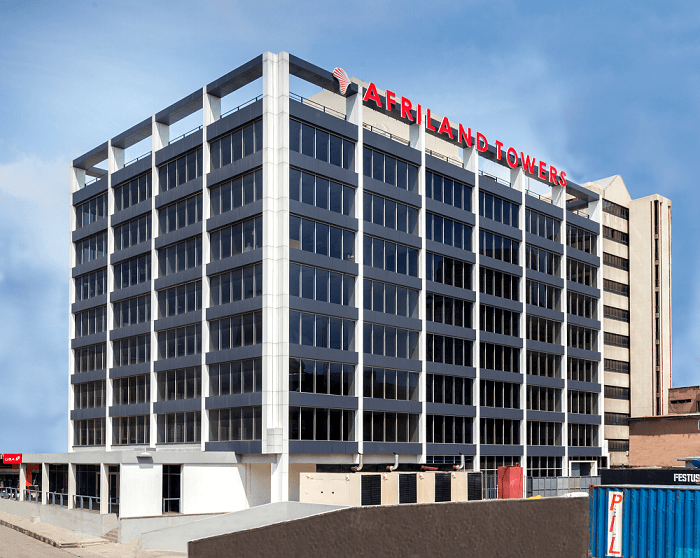
A routine Tuesday afternoon on Broad Street, Lagos Island, turned into horror when a fire swept through the seven-storey Afriland Tower, killing at least 10 people and leaving many injured.
The building, which hosts offices of the United Bank for Africa, the Federal Inland Revenue Service, and United Capital Plc, became engulfed in smoke after flames broke out around 1 pm in the basement inverter room.
Workers who managed to escape described the scene as chaotic. Adewale, who was on the fifth floor, recalled how a long power outage raised suspicion before thick smoke filled the corridors. With visibility gone, he soaked his tie in water and pressed it to his face, stumbling through the darkness until he made it out. He believed those who died were trapped near the basement, where the fire began.
Kachi, another survivor from the second floor, said he initially saw the smoke but within minutes it had spread across the building. He almost lost consciousness while gasping for air, but managed to survive after people smashed windows for escape. Many others were rushed to hospitals across Lagos, including Avon Medical, Lagos Island General, and St. Nicholas Hospital.
The tragedy claimed the lives of four staff of the Federal Inland Revenue Service, including two assistant directors, as well as several employees of United Capital Plc. Families, friends, and colleagues poured out tributes for the victims, sharing stories of their dedication, humility, and the devastating loss to their loved ones. Among the dead was a 26-year-old whose birthday was just a day away, and a nursing mother who had recently returned from maternity leave.
Rescue workers and eyewitnesses blamed poor safety systems in the building for the high casualty rate. Witnesses alleged that emergency exits had been blocked during renovations and alarms failed to function. Some victims reportedly called their families from inside the building moments before they died, unable to find a way out. First responders said the faulty inverter had a history of repeated malfunctions, warning that earlier explosions had been ignored instead of fully replacing the system.
Traders and residents around the building joined in the rescue efforts, smashing glass walls and using ropes and ladders to pull people to safety before the fire service arrived. Despite their efforts, some victims jumped from upper floors in desperation, with fatal results.
The Lagos State Fire and Rescue Service confirmed that the blaze spread quickly from the basement, filling the tower with dense smoke. Officials and first responders described the scene as one of confusion, with workers blackened by smoke struggling to breathe as they attempted to escape.
President Bola Tinubu, First Lady Oluremi Tinubu, and Governor Babajide Sanwo-Olu expressed condolences to the families and organisations affected. While the President urged stronger safety measures to prevent future tragedies, the governor announced that a probe had been launched into the cause of the fire and the safety lapses that worsened its impact.
For many families, the tragedy remains raw, with widows, children, and parents left grieving. The glass structure of Afriland Tower, once a mark of prestige, now stands as the site of one of Lagos Island’s deadliest recent workplace disasters.