
8 unconventional Nobel Prize winners who broke rules, yet changed the worl
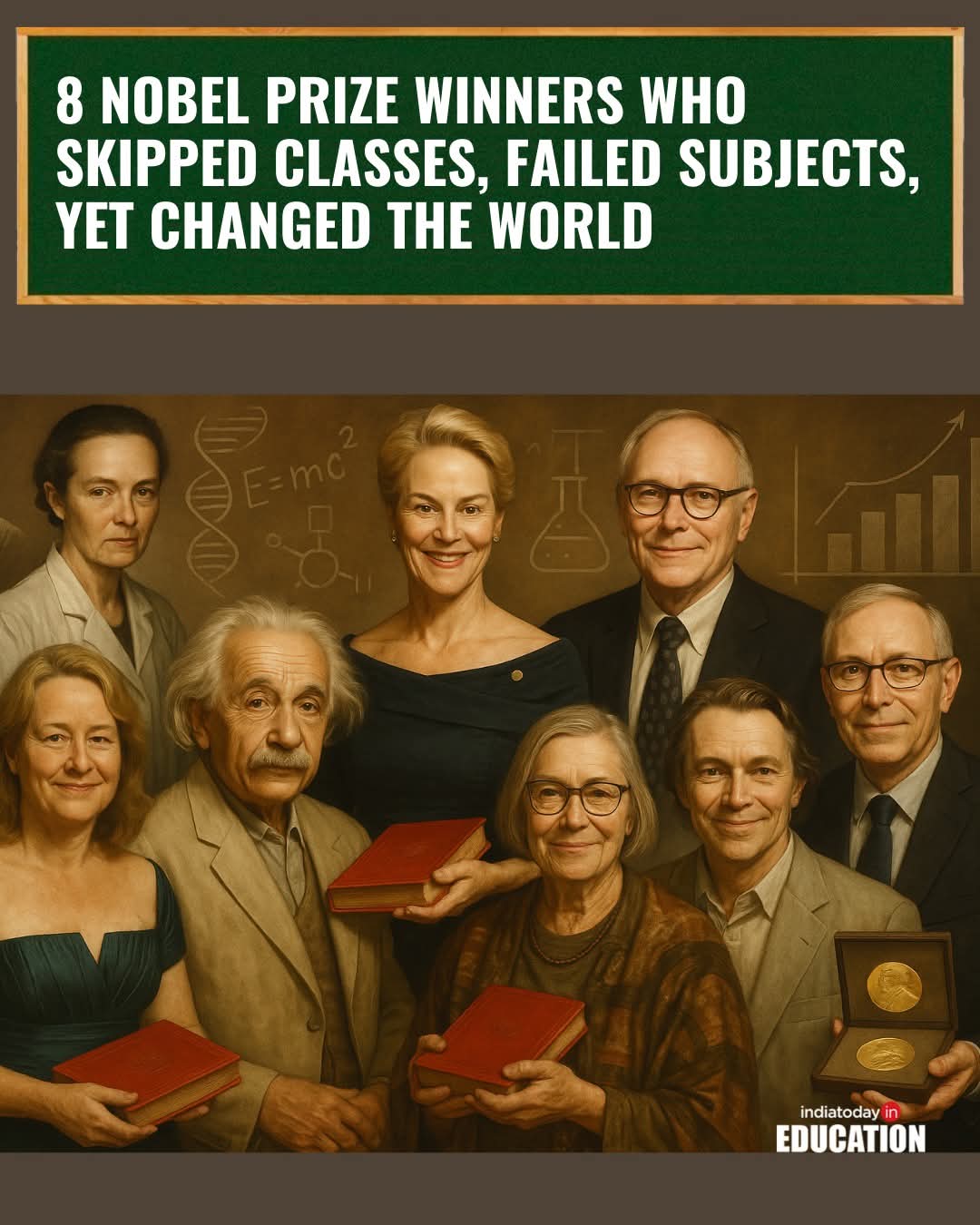
Many Nobel laureates defied conventional schooling, overcoming failures, expulsions, and doubts to achieve brilliance. (AI-generated image)
Some Nobel laureates were straight-A students from the start — but others were far from it. They were expelled, bored, distracted — or simply too curious to sit still.
Some skipped classes, others failed their exams, and a few were told outright they’d never make it in academia. Yet decades later, their names would echo through Nobel halls.
The world often celebrates polished prodigies and perfect scores, but history’s most groundbreaking minds didn’t always fit that mould.
Albert Einstein couldn’t stand routine lectures. Frances Arnold rebelled against rigid classrooms. David Card milked cows before mastering economics.
Each of them—through detours, doubts, and defiance—proved that genius can bloom far outside the neat boundaries of traditional education. Brilliance doesn’t always follow a straight academic line.
Here are a few of the most unconventional Nobel laureates who weren’t straight-A students:
ALBERT EINSTEIN — PHYSICS, 1921
Nobel Prize, unconventional nobel prize winners, Albert Einstein, Frances Arnold, David Card, Elinor Ostrom, Carol Greider, Tomas Lindahl, Ivar Giaever, Irène Joliot-Curie, unconventional education, science rebels, groundbreaking research
The young Einstein often found himself restless, skipping lectures that he deemed irrelevant, and focusing only on the physics problems that fascinated him.
In 1900, he graduated second-last in his class — and was the only one not offered a research assistant post.
Yet two decades later, Einstein’s name was etched into history when he won the Nobel Prize in Physics in 1921 for his explanation of the photoelectric effect.
The same student once dismissed as inattentive went on to redefine the universe itself.
FRANCES ARNOLD — CHEMISTRY, 2018
Nobel Prize, unconventional nobel prize winners, Albert Einstein, Frances Arnold, David Card, Elinor Ostrom, Carol Greider, Tomas Lindahl, Ivar Giaever, Irène Joliot-Curie, unconventional education, science rebels, groundbreaking research
“I was disruptive,” she told AFP, recalling how teachers often gave her classroom decoration tasks just to keep her occupied. By her teens, she stopped attending classes and was expelled.
But she studied on her own, diving into textbooks and exploring projects that sparked curiosity, still managing to pass.
Her early experiences of rebellion and self-directed learning did not deter her; they shaped her bold approach to chemistry.
In 2018, she became the first American woman to win the Nobel Prize in Chemistry for pioneering the directed evolution of enzymes, a breakthrough that transformed industrial chemistry and biotechnology.
Today, Arnold says her unconventional schooling made her value curiosity and independence. “Schools should show more flexibility for kids who think differently,” she reflected.
DAVID CARD — ECONOMIC SCIENCES, 2021
Nobel Prize, unconventional nobel prize winners, Albert Einstein, Frances Arnold, David Card, Elinor Ostrom, Carol Greider, Tomas Lindahl, Ivar Giaever, Irène Joliot-Curie, unconventional education, science rebels, groundbreaking research
Instead of seeing it as a disadvantage, Card absorbed lessons from older students, advancing quickly on his own.
“I used to listen in to what the older kids were learning,” he said — a habit that helped him accelerate naturally.
Between milking cows at dawn and driving a tractor by age 11, Card learned discipline and time management early.
Later, he pivoted from physics to economics, eventually winning the Nobel Prize in Economic Sciences in 2021 for his empirical work on labour economics, proving that real-world observation often outweighs classroom theory.
ELINOR OSTROM — ECONOMIC SCIENCES, 2009
Nobel Prize, unconventional nobel prize winners, Albert Einstein, Frances Arnold, David Card, Elinor Ostrom, Carol Greider, Tomas Lindahl, Ivar Giaever, Irène Joliot-Curie, unconventional education, science rebels, groundbreaking research
Her unconventional focus on collective resource management challenged the established assumptions of economic theory.
In 2009, she became the first woman to win the Nobel Prize in Economic Sciences, demonstrating that insightful, patient observation of communities can uncover rules and behaviours that textbooks often overlook.
CAROL GREIDER — PHYSIOLOGY OR MEDICINE, 2009
Nobel Prize, unconventional nobel prize winners, Albert Einstein, Frances Arnold, David Card, Elinor Ostrom, Carol Greider, Tomas Lindahl, Ivar Giaever, Irène Joliot-Curie, unconventional education, science rebels, groundbreaking research
She pursued her own path, eventually focusing on molecular genetics, and in 2009 received the Nobel Prize in Physiology or Medicine for discovering telomerase, an enzyme crucial for chromosome protection and cellular longevity.
Greider’s story is a reminder that initial learning challenges do not preclude scientific triumph.
TOMAS LINDAHL — CHEMISTRY, 2015
Nobel Prize, unconventional nobel prize winners, Albert Einstein, Frances Arnold, David Card, Elinor Ostrom, Carol Greider, Tomas Lindahl, Ivar Giaever, Irène Joliot-Curie, unconventional education, science rebels, groundbreaking research
Yet, his curiosity persisted, guiding him toward research that would uncover the mechanisms of how DNA repairs itself.
This resilience paid off in 2015, when he shared the Nobel Prize in Chemistry for mapping the fundamental processes that maintain genetic stability, a cornerstone of modern molecular biology.
IVAR GIAEVER — PHYSICS, 1973
Nobel Prize, unconventional nobel prize winners, Albert Einstein, Frances Arnold, David Card, Elinor Ostrom, Carol Greider, Tomas Lindahl, Ivar Giaever, Irène Joliot-Curie, unconventional education, science rebels, groundbreaking research
He explored engineering before committing to physics, a decision driven by fascination rather than grades.
His early willingness to chart his own course culminated in winning the Nobel Prize in Physics in 1973 for discoveries regarding tunnelling phenomena in superconductors, demonstrating the power of curiosity over traditional classroom success.
IRNE JOLIOT-CURIE — CHEMISTRY, 1935
Nobel Prize, unconventional nobel prize winners, Albert Einstein, Frances Arnold, David Card, Elinor Ostrom, Carol Greider, Tomas Lindahl, Ivar Giaever, Irène Joliot-Curie, unconventional education, science rebels, groundbreaking research
Her education was somewhat unorthodox: she attended a cooperative school organised by her mother rather than typical formal schooling.
She overcame societal and educational hurdles to make groundbreaking discoveries in artificial radioactivity.
In 1935, she and her husband Frdric won the Nobel Prize in Chemistry, proving that determination and hands-on experimentation can triumph over conventional schooling.
LESSONS BEFORE LAURELS
None of these Nobel winners followed the conventional formula for success. They were bored, distracted, dyslexic, or dismissed. But they shared one trait: relentless curiosity.
Perhaps their unconventional upbringing or academic life is what led to their wins later in life.
Both Frances Arnold and David Card started working young — experiences they now credit for their grounded perspective. Arnold waitressed, drove taxis, and worked as a receptionist. “You appreciate education more when you’ve worked for it,” she said.
Card, too, balanced studies with life on the family farm. Those early mornings and practical lessons in responsibility shaped the economist who would one day redefine how we think about labour markets and wages.
Their stories remind us that the path to brilliance can begin anywhere — in a noisy classroom, a quiet field, or even after failure.
Straight A’s may open doors, but persistence, imagination, and passion are what truly win the prize. Their stories show that education, at its best, is about asking daring questions, not just answering the expected ones.
(With AFP inputs)