
By Abasi Ita
The Cross River State Government has reiterated its readiness to build strong partnerships with critical stakeholders to revolutionize agriculture and boost exports, leveraging the state’s strategic location and access to global markets.
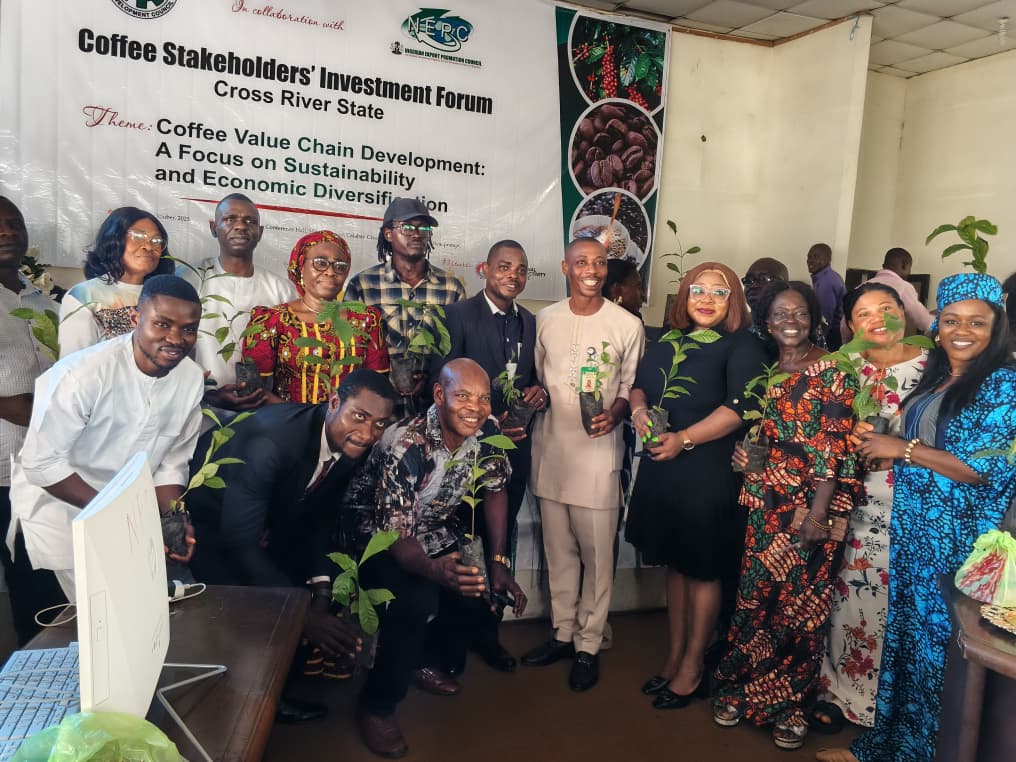
The State Commissioner for Agriculture and Irrigation, Dr. Johnson Ebokpo, stated this while declaring open a one-day Coffee Stakeholders Investment Forum in Calabar aimed at promoting sustainable coffee production, investment, and export development.
The event was organized by the Nigerian Export Promotion Council (NEPC) Cross River State Coordination Office in collaboration with the Raw Materials Research and Development Council (RMRDC) with the theme: “Coffee Value Chain Development: A Focus on Sustainability and Economic Diversification.”
According to the organisers, the forum also sought to equip local farmers with innovative concepts to enhance commercial farming for both local and export markets.
Dr. Ebokpo described the initiative as timely and in line with Governor Bassey Otu’s agricultural transformation agenda, which focuses on ensuring food security and improving export earnings.
He revealed that the state government has distributed about 100,000 coffee seedlings to farmers across the Northern and Central Senatorial Districts as part of efforts to revive coffee cultivation and establish coffee estates under a public-private partnership model.
In his welcome address, the NEPC State Coordinator, Dr. Osas Omorogbe, explained that the forum was part of the Council’s mandate to promote non-oil exports and position Cross River as a leading hub for coffee production and export in Nigeria.
Omorogbe added that the event provided a platform for stakeholders to exchange ideas, explore investment opportunities, and strengthen linkages across the coffee value chain.
Representing the Executive Director of NEPC, the Regional Coordinator for the South-South, Arc. Benedict Itegbe, in a keynote address delivered by Mrs. Sussan Sewuese Agu, emphasized the importance of adding value to coffee production and promoting local consumption. He encouraged stakeholders to explore emerging ventures such as coffee tourism, coffee-based skincare products, and coffee equipment manufacturing to enhance economic diversification.
In her remarks ,the Commissioner for Commerce, Dr. Abigail Orok Duke, reaffirmed the state government’s commitment to creating enabling policies and incentives to attract investors.
She noted that coffee was first identified as a priority product during the State Committee on Export Promotion meeting and was later adopted under the One State One Product (OSOP) initiative.
Duke assured participants that Cross River remains open for sustainable coffee investment.
The Overseeing Director of RMRDC, Dr. Obi Edith, who represented the Director-General, stressed the need for stronger collaboration among stakeholders to identify opportunities for value addition and address challenges in the coffee sector.
The technical session featured presentations by experts including Ayodele Oladipo Akinpele of the Cocoa Research Institute of Nigeria (CRIN), Prof. Susan Ohen, Dr. Assaim Assaim, and Dr. Osas’ Damian Omorogbe.
Their papers focused on sustainable agricultural practices, the role of public institutions in value chain development, investment opportunities from seed to export, and risk management frameworks for coffee investors.
Goodwill messages from National Productivity Centre, the Cross River Basin Development Authority, and the Calabar Chamber of Commerce, Industry, Mines and Agriculture (CALCCIMA) commended the organisers and called for greater collaboration to strengthen coffee production and export in the state.
The forum attracted over 100 participants from federal and state ministries, private sector organisations, research institutions, and export associations.