
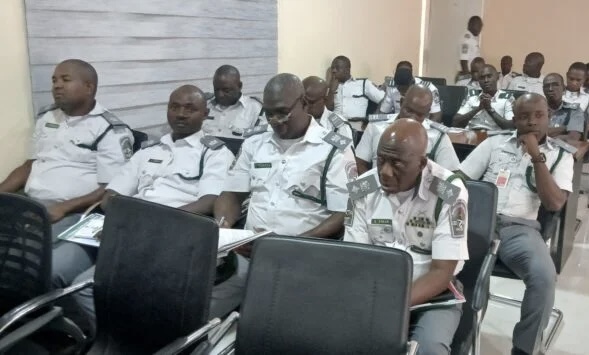
The Nigeria Customs Service has commenced a nationwide first aid training for its officers across all formations, aimed at enhancing health and safety consciousness within the Service.
The training, organised by the Customs Medical Corps, began at the Zone B Headquarters on Monday in Kaduna.
In her welcome remarks, the zonal coordinator, Nsika Umoh, lauded the comptroller-general of Customs, Bashir Adeniyi, for supporting the initiative and ensuring collaboration with the medical team to build awareness among officers.
Ms Umoh, who was represented by the Comptroller of Revenue, Abubakar Alkhali, stated that the gesture would help alleviate workplace health challenges and save lives.
“This training will help curtail challenges at the workplace by equipping the officers with the right knowledge to save lives, including their own. When you know the right thing to do, you have already solved half of the problem,” she said.
Ms Umoh explained that only a few officers from each command within Kaduna were selected to participate and urged them to share the knowledge gained with their colleagues in their respective formations.
“We could not bring all officers together at once, but those selected are expected to step down the knowledge to others as part of the awareness creation,” she added.
In his presentation, the comptroller of customs and chief medical director of the NCS Hospital, Karu, Abuja, Nanman Nandang, said the training was part of the directive of the CGC to take first aid sensitisation across all Customs formations in Nigeria.
Mr Nandang said the aim was to equip officers with basic first aid knowledge to manage emergencies both at the workplace and at home.
“Before getting to the hospital, one must first be alive. That is why first aid knowledge is essential, especially for officers who often face injuries during enforcement duties, including snake bites and other hazards,” he said.
According to him, the training will cover key topics such as introduction to First Aid Cardiopulmonary Resuscitation.
He also mentioned management of bleeding, choking, relief, and wound care
and recovery position, as well as the management of spinal injuries.
Mr Nandang added that the exercise was designed to be practical and intensive, focusing on essential life-saving skills and emergency response.
(NAN)