
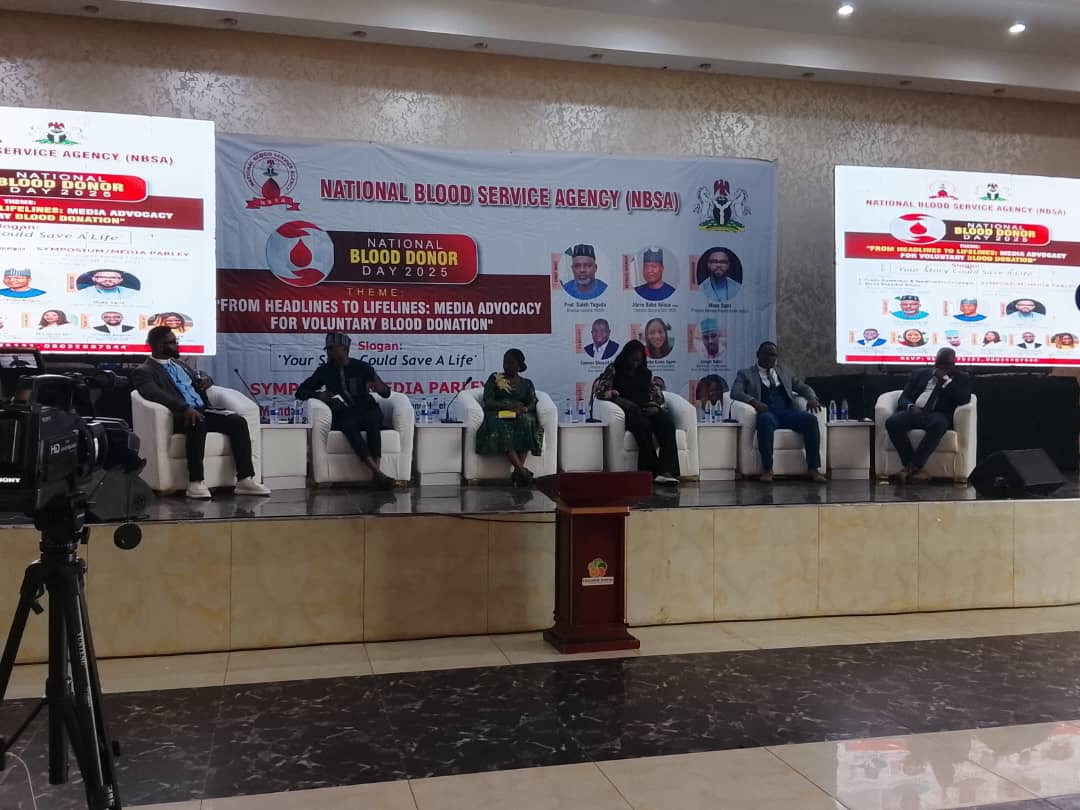
The Director-General of the Voice of Nigeria, Jibrin Baba Ndace, has urged the Federal Government and the media to treat blood donation as a national emergency, warning that the country’s current supply remains dangerously inadequate.
Ndace made the call on Monday in Abuja during a symposium and media parley themed “From Headlines to Lifelines: Media Advocacy for Voluntary Blood Donation”, held to commemorate National Blood Donor Day 2025.
The event brought together editors, broadcast and print journalists, digital media practitioners, donor groups, civil society organisations, and development partners.
The gathering also featured the launch of the Media Blood Donation Challenge 2025 and the unveiling of the NBSA Digital Media Toolkit for Journalists, both aimed at strengthening media advocacy for voluntary blood donation nationwide.
Ndace said Nigeria must adopt a new national mindset on blood donation.
“It is time we treat blood donation as a national emergency,” he declared.
He pledged VON’s full support for the nationwide campaign, saying the broadcaster would integrate blood transfusion messages into its diaspora programming to give the initiative global visibility.
According to him, professional journalism must go beyond generating digital content.
“It is no longer enough to simply hold a phone and record. What separates journalists is their capacity to understand and interpret context,” he said.
Ndace said the campaign was part of efforts to align Nigeria with global health standards, noting that countries worldwide were prioritising reforms in the health sector.
He added that VON would work with organisations promoting peace, unity and health, deploying jingles, documentaries, interviews and digital campaigns to raise awareness.
He cautioned media houses against amplifying unverified claims, warning that misinformation—especially on health matters—could put lives at risk.
“Social media should not dictate our narratives. Our duty is to provide accurate and responsible journalism,” he said.
Earlier, the Director-General of the National Blood Service Commission, Professor Saleh Yuguda, raised concerns over the deep-rooted misconceptions surrounding blood donation.
Yuguda said cultural beliefs, misinformation and religious fears had discouraged many Nigerians from donating blood voluntarily.
“With the help of the media, you can help us allay these anxieties,” he told journalists.
He urged the media to humanise the need for blood by sharing donor and recipient stories, stressing that consistent storytelling could inspire participation.
The NBSA boss revealed that Nigeria still provides less than 40 per cent of its annual blood requirement.
He warned that the shortage forces hospitals to rely on unsafe emergency replacement donations.
“We cannot guarantee their safety because of the fragmented nature of our blood services,” he said.
Yuguda noted that the shortage affects trauma care, maternal health, child health, cancer treatment, surgeries and chronic conditions.
He said every uncollected unit of blood translates into a life at risk.
Representing the Federal Ministry of Health and Social Welfare, Director Gloria Uzor-Igwe urged journalists to sustain the advocacy beyond a one-off event.
She called for strategic engagement with youth groups, faith organisations, gender advocates, market associations and community networks.
“Let us ensure blood donation becomes part of Nigeria’s collective identity,” she said.
Uzor-Igwe reaffirmed the Ministry’s commitment to expanding donor recruitment, quality assurance and supply chain efficiency, but stressed that government efforts must be matched by public participation.
The Chairman of the Nigeria Union of Journalists, FCT Council, Grace Ike, described journalists as crucial to shaping public perception and inspiring life-saving action.
“Our stories can inspire action and correct wrong beliefs,” she said.
Ike commended the NBSA for its new initiative, saying the union would fully support efforts to promote voluntary blood donation.
She said many hospitals struggle daily due to shortages, leaving families under pressure during emergencies.
“If more Nigerians donate voluntarily and regularly, many lives will be saved,” she added.
She assured the commission that journalists in the FCT would continue to champion humanitarian causes that strengthen the nation’s health system.