
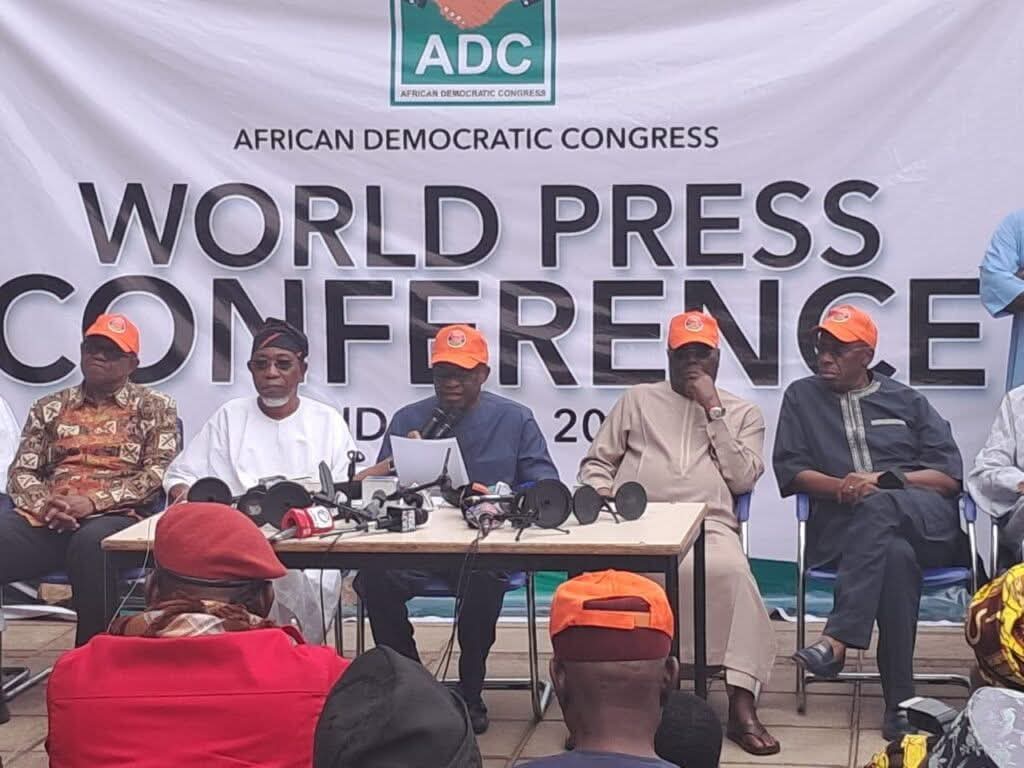
The African Democratic Congress (ADC) has accused the All Progressives Congress (APC) of orchestrating a covert plan to establish a one-party state ahead of Nigeria’s 2027 general elections. The party also alleged that the Independent National Electoral Commission (INEC) is being used to weaken opposition parties.
At a press conference held at the Yar’Adua Centre, Abuja, on Thursday, the ADC National Chairman, David Mark, called for the immediate removal of INEC Chairman, Professor Amupitan Joash, whom he accused of bias and unlawful conduct.
Mark’s demand follows INEC’s announcement on Wednesday that it would delist key ADC figures, including Mark himself and the party’s National Secretary, Rauf Aregbesola.
INEC’s National Commissioner and Chairman of the Information and Voter Education Committee, Mohammed Haruna, explained that the commission was complying with a court order directing it to maintain the status quo while a substantive case is determined.
The ADC has been embroiled in an internal leadership crisis since 2025. The dispute arose after a new National Working Committee (NWC) led by Mark was inaugurated in July 2025, following the expiration of former National Chairman Ralph Nwosu’s tenure in August 2022.
Although Nwosu was reportedly involved in facilitating the leadership transition, his role sparked opposition from rival factions within the party. The disagreement has since escalated into multiple court cases, with different groups claiming legitimacy over the party’s leadership.
The internal turmoil has raised concerns about the ADC’s readiness for the 2027 elections.
Speaking at the press conference, Mark claimed that Nigeria has witnessed sustained attacks on freedom of association over the past three years—a fundamental democratic principle.
He alleged that the ultimate goal is to ensure that by 2027, President Bola Tinubu emerges as the only viable candidate for Nigerians, despite widespread hardship and rising insecurity.
“The agenda is very clear: to create a situation where, in 2027, President Bola Ahmed Tinubu emerges as the only option left for the people, despite the widespread suffering and wanton killings going on across the country,” Mark said.
“The twin challenges of deepening poverty and a worsening security situation did not just happen. They are direct consequences of the failure of this government. They know that Nigerians will not want this to continue. They know Nigerians will vote them out. This is why they would do anything to hang on to power by hook or crook.”
Mark insisted that his assumption of the ADC chairmanship followed due process. He said a National Executive Committee (NEC) meeting was convened on July 29, 2025, and was monitored by INEC officials. The meeting, he said, dissolved the old NWC and ratified a caretaker committee, with himself as National Chairman and Aregbesola as National Secretary.
“A formal report of these resolutions was subsequently communicated to INEC. On September 9, 2025, INEC uploaded the names of the relevant NWC members based on the NEC resolutions,” Mark stated.
He pointed to the case of Nafiu Bala, one of the deputy national chairmen in the dissolved NWC, who resigned from his position on May 17, 2025. According to Mark, Bala’s resignation was transmitted to INEC on August 12, 2025.
Nevertheless, on September 2, 2025—four months after his resignation—Bala approached the court seeking recognition as ADC chairman. Mark noted that by that date, INEC was already aware of the July 29 leadership change and Bala’s earlier resignation.
The ADC’s crisis is the latest in a series of internal disputes that have plagued several Nigerian opposition parties in recent years. The party’s ability to present a unified front ahead of the 2027 elections remains uncertain as legal battles continue.