
By Melvin Tejan Mansaray, Abuja Nigeria
Members of the ECOWAS Parliament on Tuesday 12th May, 2026 extensively deliberated on the ‘ECOWAS Compact of the Future of Regional Integration.’
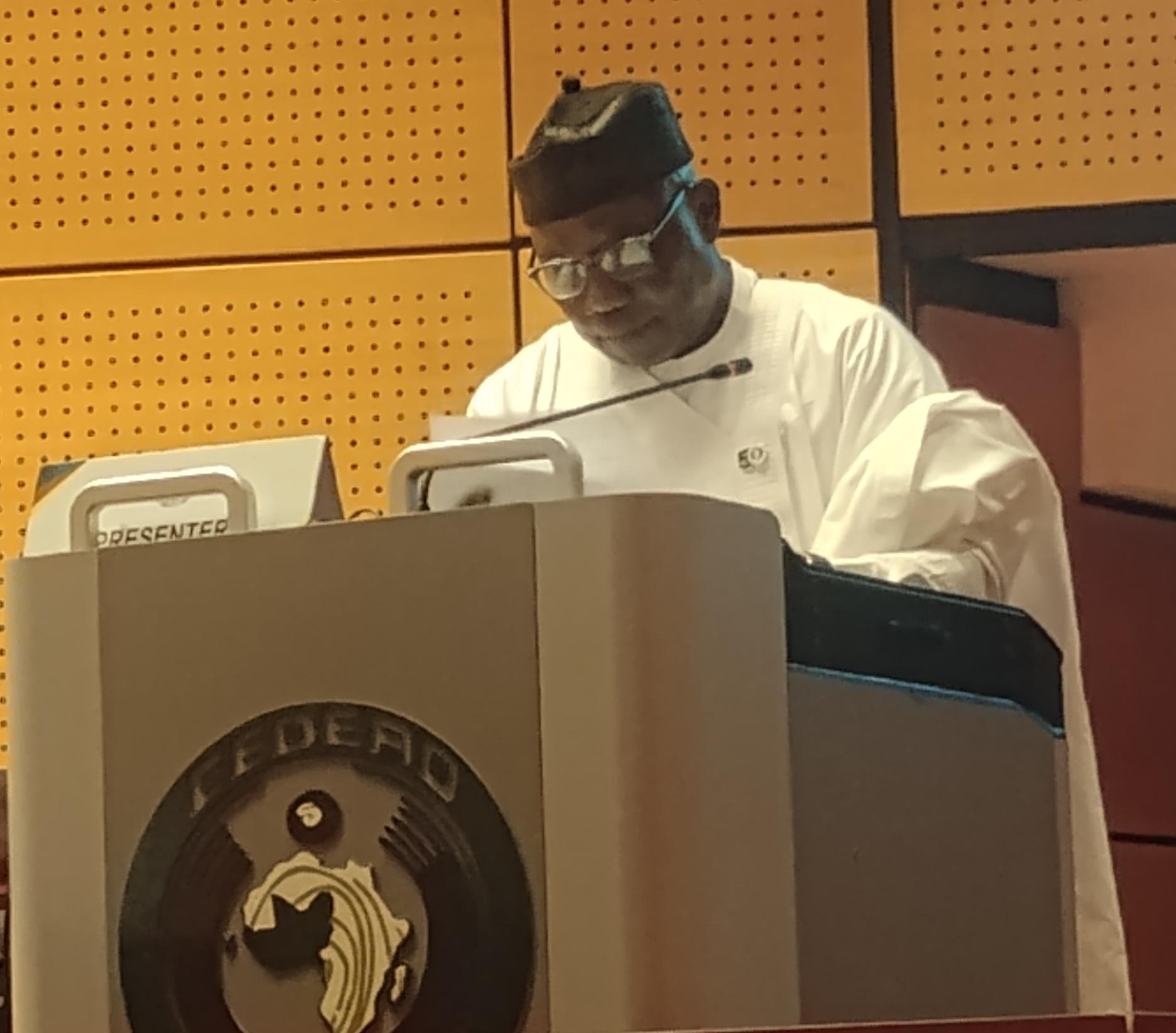
The document, ‘ Processes Towards the Compact of the Future of Regional Integration’ presented by Ambassador Dr. Abdel-Fatau Musah, Commissioner of Political Affairs, Peace and Security ECOWAS Commission provided details on the outcome of regional consultations in preparation for the ‘Special Summit on the Future of Regional Integration in West Africa,’ a “strategic framework to renew, reposition and strengthen the West African integration project in response to political, security, economic, institutional and social pressures.”
“It’s intended to operationalize the ECOWAS Vision 2050 by shifting the Community from an elite-driven “ECOWAS of States” toward a responsive, accountable and people-centered “ECOWAS of the Peoples,” H.E. Dr. Musah remarked.
The Pact recognizes that West Africa is facing a convergence of crises, including insecurity, democratic backsliding, unconstitutional changes of government, weak implementation of regional commitments, economic fragility, youth unemployment, gender inequality, technological disruption and a declining citizen’s trust in regional institutions.
The ECOWAS Pact of the Future contained the following objectives:
” Revitalize regional integration by transforming ECOWAS from a declaratory institution into a delivery-oriented Community with measureable outcomes.
Restore confidence in ECOWAS by addressing citizens discontent, credibility gaps and the perception that integration has not sufficiently improved daily life.
Strengthen peace, security and democratic governance through collective security mechanisms, constitutional order, early warning and stronger response to terrorism and violent extremism.
Accelerate economic transformation and shared prosperity through intra-regional trade, industrialization, regional value chains, food sovereignty, infrastructure and monetary cooperation.
Promote science, technology, Innovation and digital transformation through digital connectivity, cybersecurity, artificial intelligence governance and unified digital market.
Empower youth, women and future generations as central actors in governance, development, peacebuilding, entrepreneurship, education, innovation and intergenerational justice.
Reform ECOWAS institutions and implementation mechanisms by strengthening accountability, financing, monitoring and evaluation, enforcement and national alignment, and,
Position ECOWAS as a strategic geopolitical actor able to protect regional sovereignty, coordinate external partnerships and advance West Africa’s interest in a multipolar world.”
The ECOWAS Pact of the Future contains six pillars -;
Sustainable economic transformation and regional prosperity; peace, security, stability and democratic governance; science technology, innovation and digital transformation; youth, women and future generations; institutional reforms, partnerships and implementation mechanisms and, ECOWAS geopolitical positioning and strategic autonomy.
According to H.E Dr. Musah;
“The Pact is both a reform agenda and survival strategy for regional integration. Its success will depend on political will, institutional discipline, sustainable financing, citizens ownership, parliamentary oversight and effective implementation across Member States.”
In their various submissions, twenty-four ECOWAS Lawmakers took to the Floor of the Chamber of the ECOWAS Parliament’s 2026 First Ordinary Session holding at the International Conference Center, Area 10, Abuja Nigeria, registering the following concerns.
Hon. Abdul Kargbo applauded the timing of the Compact saying that it is coming at a crucial time that the regional project is facing large scale governance failures. He urged for boldness in addressing democratic coups which he said when not addressed gives incentives for military coups.
A Lawmaker, opined that if ECOWAS is to be sovereign and people-centered, it must be able to create jobs for its people to discourage them from making dangerous migration trips to North Africa and ghastly Europe. He called for the federalizing of ECOWAS as in the EU, highlighting that, “it’s time for ECOWAS to stop being the horse that carries others, but one that moves itself forward.”
Another MP deposited that:
“When we sanction states, we sanction the people. It’s time for ECOWAS Parliament to be an actor not a spectator.”
Hon. Adama contributed that the Alliance of Sahel States (AES) leaders frowned at ECOWAS because it condemned military coups but failed to do the same when constitutions are being manipulated by civilian governments. She also enquired about the monitoring and evaluation mechanisms for the Pact and also lamented that many checkpoints on highways in the subregion impedes the objective of free movement.
Hon. Tunkara praised the six pillars, welcoming the proposals contained in the Pact that aims to transition the ECOWAS Parliament from an Advisory to a Mandatory body.
Another Lawmaker, urged for political will if the Pact is to achieve its objectives as other MPs welcomed the idea of moving ECOWAS from a talk shop, noting that transitioning to an ECOWAS Parliament of mandatory body will give it biting powers. The MP however expressed concern about the omission of direct election of ECOWAS MPs from the document. He asked about how enforcement will be maintained when even the Community Court’s decisions are sometimes ignored by some member states.
Hon. Abiante expressed doubts in the achievement of the Pact’s objective, noting that, “this is not the first time.” He critiqued the logic of engaging the AES now asking, “what has changed in terms of convergence? What is to be monitored and evaluated when we don’t even know? If previous targets of the ECOWAS have not been met, how will this Pact succeed?”
Other Lawmakers called for assimilation, while Hon. Bah raised concern about the specifics of resetting ECOWAS.
There were also concern about how ECOWAS can fund itself one hundred percent.
Hon. Memuna Sesay welcomed the idea of re-engaging the AES, adding that it is a matter of security threat to other nations.
“ECOWAS missed its way on AES,” She argued.
Hon. Minirr raised a question on the progress of single currency and urged for improved investors confidence which was re echoed by Hon. Nasiru who noted that ECOWAS must have zero tolerance for leaders who tamper with their country’s constitution to have a third term.
There were also a concerns raised about what kind of election will be used for direct membership into the ECOWAS Parliament, the need for investment in education, health, and the financing of ECOWAS through community levy.
“Some countries owe a lot of arrears in payment of Levey,” Hon. Keitta reminded colleagues.
Hon. Fatmata raised the issue of forty percent of women’s representation urging that it should not be overlooked.
Hon. Konneh questioned the huge foreign influence in ECOWAS, while Hon. Veronica Kadie Sesay appreciated the proposed Pact noting that:
“This is what we want to see in ECOWAS, reality and visibility.”
She appealed for the protection of lives and livelihoods, urging ECOWAS to learn from the Rwanda experience and the Sierra Leonean example in addressing the issue of AES.
” The work of the ECOWAS Commission is heavy, I don’t envy you. Bring back all states together,” she appealed.
H.E. Dr. Musah in response thanked the MPs for their useful contributions and constructive approach towards the debate of the Pact, assuring them that as in the many other engagements, their concerns will be factored into the final revised document that is to be approved by the Authority of Heads of State.
He reminded ECOWAS MPs that:
“Parliament’s role is critical and must not just be advisory.”
H.E Dr. Musah also implored MPs to work collaboratively with the Commission and other arms and institutions of the ECOWAS.