
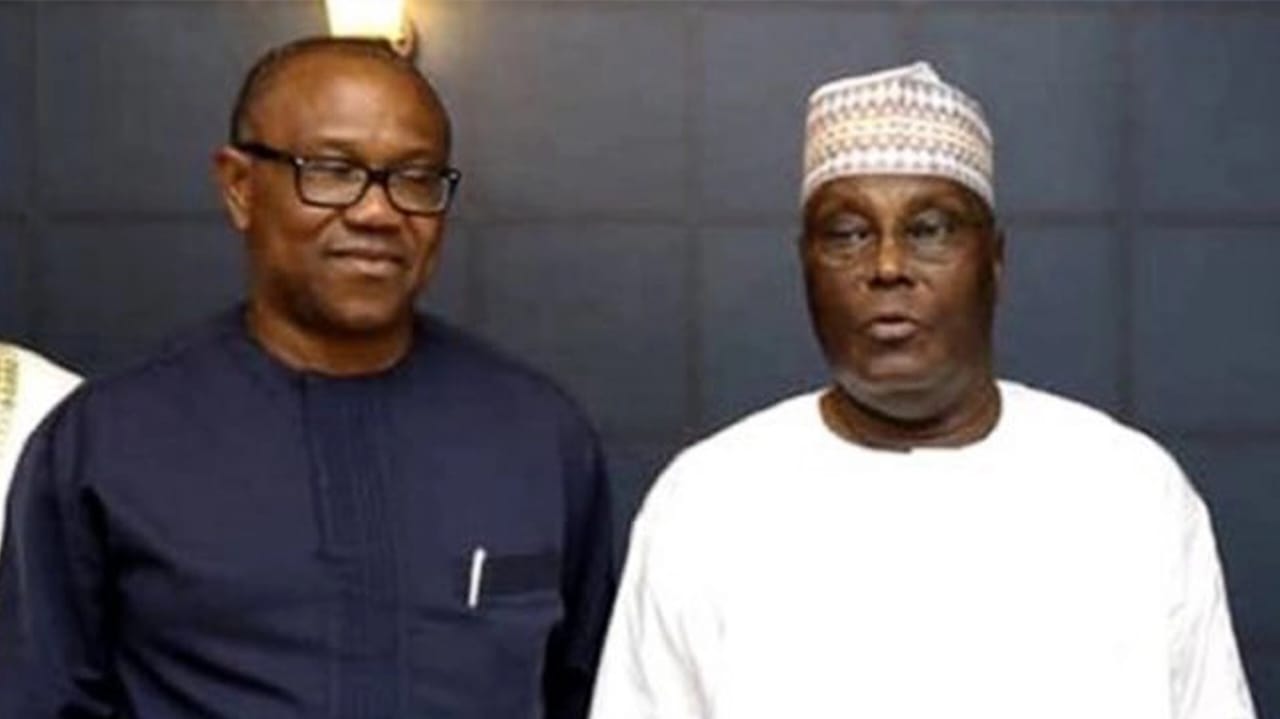
The Northern Ethnic Youth Group Assembly (NEYGA) has taken a swipe at former Vice President Atiku Abubakar and former Anambra State Governor Peter Obi, accusing both of politicising Nigeria’s worsening security situation.
In a strongly worded statement, the group faulted the duo for their recent remarks on the wave of school attacks and kidnappings in parts of Oyo and Borno States, where pupils and teachers were abducted by gunmen. NEYGA argued that such comments were insensitive and capable of undermining national unity during a security crisis.
The group also urged opposition politicians in Nigeria to adopt the approach of leaders in countries such as the United States and Israel, where political differences are often set aside during major security emergencies like the 9/11 attacks and the October 7 Hamas assault.
Obi had recently criticised the administration of President Bola Ahmed Tinubu, saying it lacked the capacity to protect schoolchildren and had allowed them to become “pawns in a ransom economy.” Atiku, on his part, had described the deteriorating security situation as a failure that mocked the government’s Safe Schools Initiative, even suggesting that continued abductions called into question the legitimacy of leadership in Aso Rock.
Reacting, NEYGA dismissed both statements as political exploitation of a national tragedy, insisting that leaders should avoid using the suffering of children as a tool for political gain. The group further alleged that both Atiku and Obi were part of past administrations that failed to effectively tackle the roots of Nigeria’s insecurity.
According to NEYGA spokesperson Alhaji Ibrahim Dan-Musa, it was “unethical and unpatriotic” for former office holders to criticise the current situation without acknowledging their own roles in earlier governance failures.
The group specifically claimed that the administration during Atiku’s tenure as Vice President failed to act decisively against early Boko Haram activities led by Mohammed Yusuf, suggesting that timely intervention could have prevented the escalation of insecurity.
On Obi, NEYGA argued that his time in public service also coincided with governance lapses that allowed kidnapping and terrorism to grow unchecked, leading to the current crisis.
NEYGA further maintained that opposition figures in other countries typically support their governments during crises instead of intensifying criticism, citing examples such as global responses to major terrorist attacks and mass casualty events.
The group concluded by urging both Atiku and Obi to exercise restraint in their public commentary on national security, warning that politicising such issues could deepen divisions at a sensitive time.
In their separate reactions to recent abductions, Obi had described the situation as heartbreaking, stressing that Nigeria was failing to protect its children, while Atiku noted that dozens of students and teachers were still in captivity following coordinated school attacks in both Borno and Oyo States.