
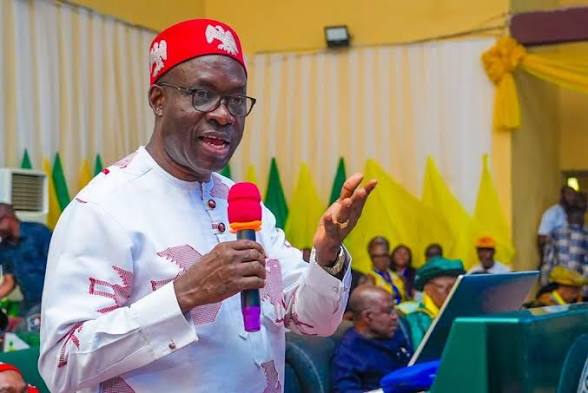
Anambra State Governor, Prof. Chukwuma Soludo, has called for deeper intellectual engagement on what he described as the “Igbo question” within Nigeria, urging a shift from agitation to structured, evidence-driven national dialogue.
Soludo made the appeal on Saturday in Awka after attending a stage performance titled The Tale of Two Nnamdis, written by Tobe Osigwe and directed by Prof. Uche Nwaozuzu. The play was staged by students of the Department of Theatre Arts and Film Studies at the University of Nigeria Nsukka.
Speaking at the Light House, Awka, the governor expressed concern that issues affecting the Igbo people have not been sufficiently explored through sustained academic and political discourse, especially in relation to lingering Biafra-related agitations nearly 60 years after the civil war.
He praised the student performers for sparking what he described as a critical conversation that has long been absent from mainstream debate, noting that universities should play a stronger role in shaping such discussions.
Recalling his experience during the civil war, Soludo said the conflict left lasting personal scars, including the death of his mother and his father living for years with a bullet lodged in his body.
“I saw the war very clearly. I am a Pan-Africanist and a proud Nigerian. Ndigbo need Nigerians, Nigerians need Ndigbo. Our prosperity grows when we take advantage of a wider space,” he said.
The governor also criticised forms of agitation that, according to him, end up harming the same people they are meant to protect, referencing prolonged sit-at-home directives in parts of the South-East.
While acknowledging differing political opinions in the region, Soludo said he remains committed to dialogue and democratic engagement, drawing inspiration from Nigeria’s first President, the late Nnamdi Azikiwe.
“Zik taught us the politics of bargaining. He helped shape the First and Second Republics through negotiation and engagement,” he noted.
Soludo further questioned what he described as a contradiction within Igbo political aspirations, seeking national leadership while still debating their place within the Nigerian federation.
He also expressed willingness to participate in a structured national conversation involving various stakeholders, including groups linked to the detained leader of the Indigenous People of Biafra (IPOB), Nnamdi Kanu.
According to him, any genuine attempt to address the Igbo question must be rooted in open dialogue and mutual respect.
“Any group that advances the conversation of the Igbo question in Nigeria will have our support. You cannot force consensus in a republican system, you must engage,” he added.