
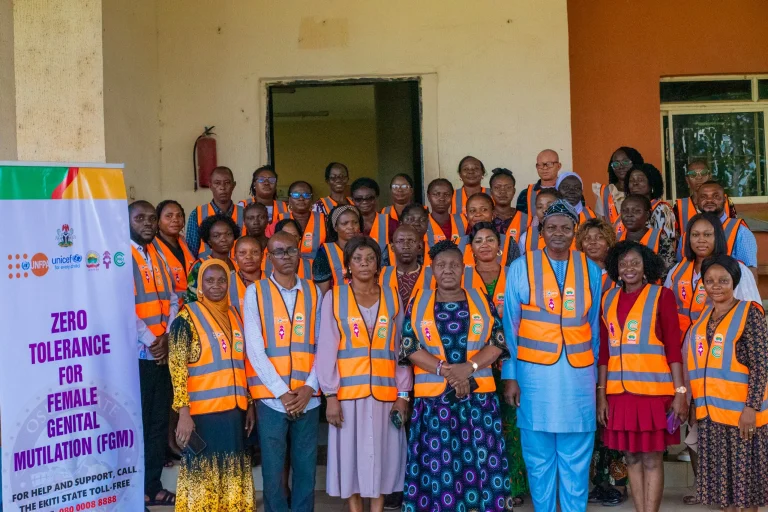
The Ekiti State Government has restated its resolve to eliminate Female Genital Mutilation (FGM) and all forms of gender-based violence, describing the practice as harmful, medically unnecessary, and a violation of human rights.
The Commissioner for Health and Human Services, Dr. Oyebanji Filani, said FGM offers no health benefits and urged parents—especially mothers—to stop subjecting their daughters to the practice despite its known dangers.
Filani, who was represented by the Permanent Secretary of the ministry, Mrs. Olusola Gbenga-Igotun, spoke on Saturday in Ado Ekiti during a two-day capacity-building programme for health educators and assistant health educators in the state.
The training, organised by the United Nations Population Fund (UNFPA) in partnership with the Ekiti State Ministry of Health, aimed at strengthening advocacy and community sensitisation against the continued practice of FGM.
He warned that anyone found carrying out or supporting FGM would face prosecution, stressing that the state government would not tolerate violations of the law.
According to him, FGM is associated with serious short- and long-term health complications, including severe pain, excessive bleeding, shock, and increased vulnerability to infections such as HIV, hepatitis, and other blood-borne diseases.
He added that the practice has no medical justification and is globally recognised as a violation of human rights due to its harmful physical and psychological consequences.
Participants at the training were urged to intensify awareness campaigns within their communities and workplaces to promote the abandonment of the practice.
Speaking at the event, UNFPA representative Mrs. Agnes Oyeniran explained that FGM can lead to severe psychological effects such as anxiety, depression, and trauma, as well as dangerous obstetric complications including prolonged labour, perineal tears, postpartum haemorrhage, emergency Caesarean delivery, and infertility caused by reproductive organ damage.
She called on health workers and stakeholders to step up advocacy efforts in religious centres, community gatherings, and other public spaces to accelerate the elimination of the practice.
Also speaking, the State Gender Officer, Mrs. Dupe Amodu, noted that global health authorities, including the World Health Organisation (WHO), classify FGM as both a human rights violation and a major public health concern.
She expressed concern that the practice continues to cause long-term complications such as sexual dysfunction, infertility, and psychological distress, while also contributing to maternal and infant mortality due to excessive bleeding and childbirth complications.
On behalf of participants, Mr. Dapo Olatunbosun pledged commitment to intensify sensitisation campaigns across communities in Ekiti State to ensure wider awareness and behavioural change against FGM.