
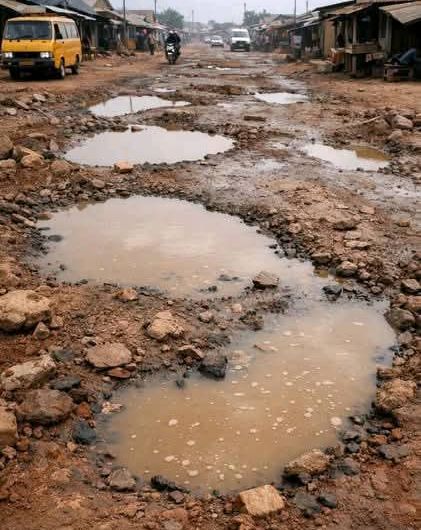
Stakeholders in Borno, Yobe, and Adamawa have expressed concern over the deplorable conditions of some major roads in the North-East.
The stakeholders made this known while responding to a survey on the state of major roads in the country.
The years of insurgency have restricted access to many highways, making routine maintenance and reconstruction difficult, while the use of heavy-duty military vehicles has accelerated wear and tear on existing road infrastructure.
According to them, the poor condition of the roads undermines trade and commerce and threatens agriculture, peace, and the region’s security.
Ali Bukar, a commercial car driver in Maiduguri, identified the 105.6km Maiduguri-Monguno Highway as one of the most dilapidated roads in the state.
He said the critical corridor linking Maiduguri and northern Borno communities served as a major military and humanitarian supply route to Monguno, Marte, Kukawa, and communities around the Lake Chad Basin.
Mr Bukar said that although rehabilitation works had resumed on the road, large portions of it remained difficult to navigate.
“Before the rehabilitation commenced, the journey was extremely difficult. Vehicles broke down regularly, and transport costs increased due to constant repairs. Things are improving gradually, but there are still sections that require urgent reconstruction,” the driver said.
Mr Abba Kolo, another driver, said the Dikwa-Marte-Monguno road was also in a bad state, as several portions of it had virtually disappeared due to years of neglect.
“There are communities where movement becomes extremely difficult during the rainy season. Many farmers struggle to move produce to markets because vehicles avoid some sections of the road,” he said.
The Maiduguri-Dikwa Highway also continued to experience challenges despite periodic maintenance interventions.
Several sections of the road were washed away by erosion, and the pavement failure requires comprehensive and urgent rehabilitation. The Dikwa-Monguno corridor requires substantial reconstruction, particularly in sections damaged by erosion and prolonged military operations.
Musa Gana, a fish trader in Baga, said drivers often charged excessive fares due to the condition of the Monguno-Baga Road, a critical corridor to the Lake Chad fishing hub.
Babagana Goni, another commuter, said that the Kukawa-Damasak and Damasak-Gudumbali roads were among the major federal routes requiring urgent intervention. He said that the roads provide access to border communities and are strategically important for trade and security operations along the Niger Republic axis.
Similarly, the Bama-Banki Highway, which links Nigeria to neighbouring Cameroon, continued to require extensive reconstruction despite receiving temporary repairs over the years.
Ba’a Mustapha, a businessman who described the route as one of the most important international corridors in the North-east, said the road had remained in very poor condition due to insecurity.
According to Mr Mustapha, heavy trucks still pass through the Banki road linking several countries, including Chad, Niger, and Cameroon, noting that the road has not been renovated for more than two decades.
Ibrahim Hassan, a truck driver operating along the Maiduguri-Bama-Banki route, said poor road conditions significantly increase transportation costs.
“The road is strategic because it connects Nigeria and Cameroon. When roads are bad, the cost of transporting goods rises, and businesses suffer,” he said.
There are growing concerns over the condition of the Biu-Damboa-Maiduguri corridor. Residents and transport operators say the road has suffered years of neglect despite serving as a critical gateway linking southern Borno to the state capital.
Bashir Mustapha, a businessman in Damboa, said rehabilitation of the road would significantly improve commercial activities across southern Borno.
“The road is very important for farmers, traders and travellers. We hope the federal government extends the current intervention beyond Biu to Damboa and Maiduguri,” he said.
Muktar Suleiman, the spokesman of the National Union of Road Transport Workers in Borno, expressed concern over the condition of several federal highways in the state.
Mr Suleiman said transport operators had continued to bear high costs due to poor road infrastructure.
“Many of the roads were affected by insurgency and could not be maintained for years. Vehicle maintenance costs have increased significantly while travel times have become longer,” he said.