
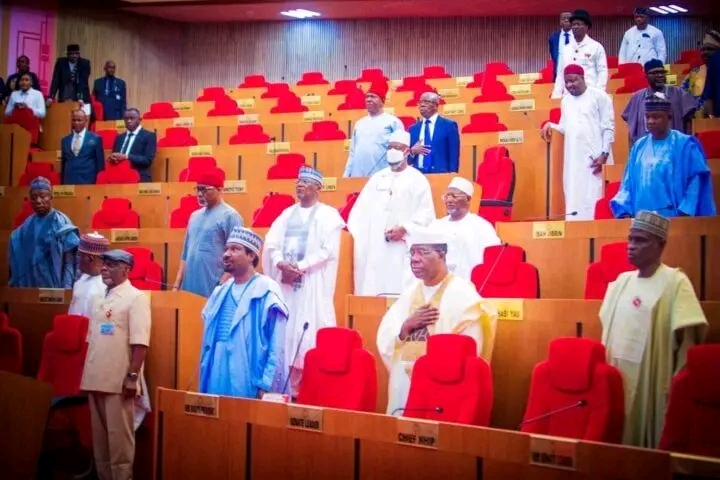
The Senate has scheduled amendments to the 1999 Constitution to provide for the establishment of state police in Nigeria this week, with an indication that the bill will be transmitted to the 36 State Houses of Assembly for further legislation once passed.
Senate Leader, Senator Opeyemi Bamidele, disclosed this in a statement issued by his Directorate of Media and Public Affairs on Monday.
He said all stakeholders across the federation were aligned with the National Assembly on the establishment of state police.
Bamidele said the National Assembly had resolved to isolate the state police provision from the broader ongoing constitutional amendment and pass it separately due to its national urgency.
“Our position is very clear on state police. We are standing with Nigerians on the issue of state police. All strata of the federation have made it clear that there cannot be a better time to establish a state police than now,” he said.
He confirmed that President Bola Tinubu and all state governors were in support of the bill, adding that the legislative week beginning Tuesday would be a crucial one for the Senate.
“We came to the conclusion that we are going to pass the constitutional amendment in this respect to make a provision for the state police. If I can tell you as of today, that will come to fruition this very week because there is no need to allow any further delay,” Bamidele said.
He said the National Assembly leadership had held a series of meetings in the past week with the Office of the Attorney-General, the Chief of Staff to the President, Rt. Hon. Femi Gbajabiamila, Inspector-General of Police Tunji Disu, and other stakeholders, and expressed confidence that the bill was ready for passage.
“They had been in a series of meetings with the office of Attorney-General, Chief of Staff to the President, Rt. Hon. Femi Gbajabiamila; Inspector-General of Police, Mr. Tunji Disu and other stakeholders in the last one week and that is why I can sit here to tell you that we’re pursuing that this week,” he said.
Bamidele explained that after passage by the National Assembly, the bill would be transmitted to the state assemblies for ratification, noting that the approval of at least two-thirds of the 36 state assemblies was required before the President could assent to it.
“The bill can as well be on its way to the 36 States Houses of Assembly as soon as possible because you know we will need two-thirds of the state assemblies to approve it before the president can assent to it. The president is also with us on this proposal. I am sure he cannot wait for the bill to come to him for assent,” he said.
Chief of Staff to the President, Femi Gbajabiamila, had earlier disclosed that Tinubu would receive a comprehensive report on the proposed creation of state police as consultations on the constitutional framework for its establishment approached completion.
The establishment of state police has been one of the most debated constitutional issues in Nigeria in recent years, driven by the country’s worsening security situation and the widely held view that a single, centralised federal police force is inadequate to tackle the diverse and geographically dispersed security challenges facing the country.
Section 214(1) of the 1999 Constitution currently provides that “There shall be a Police Force for Nigeria, which shall be known as the Nigeria Police Force,” effectively prohibiting the establishment of state or local government police forces. Any change to this provision requires a constitutional amendment, which must be passed by the National Assembly and ratified by at least two-thirds of the 36 State Houses of Assembly before the President can sign it into law.
Calls for state police have grown louder in recent years, particularly following escalating incidents of banditry, kidnapping, farmer-herder conflicts, and insurgency across various parts of the country. Proponents argue that state governments are better positioned to recruit, deploy, and supervise police officers who understand local terrain, languages, and community dynamics.
Critics, however, have raised concerns about the potential for abuse of state police forces by governors to suppress political opponents and intimidate citizens.
Tinubu has publicly expressed support for the establishment of state police as part of his administration’s broader security reform agenda.