
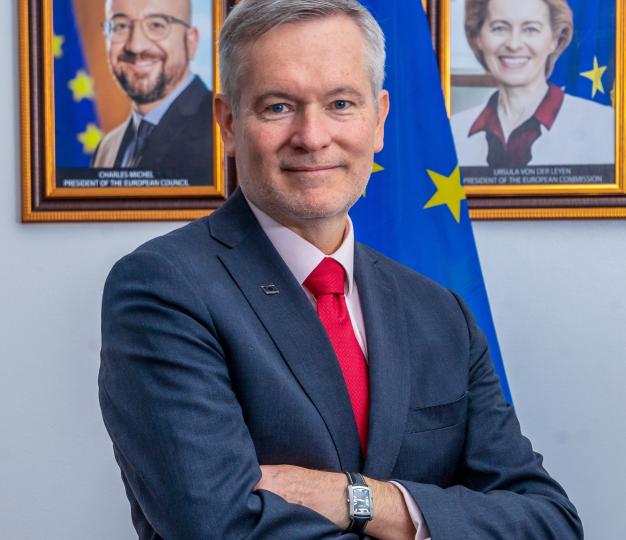
The European Union has underscored the growing importance of Nigeria’s creative sector in generating employment opportunities, building skills, and empowering young people economically.
According to the EU, industries such as Kannywood are playing a major role in converting raw talent into sustainable livelihoods, particularly among Nigerian youths.
This was contained in a statement issued on Monday by the European Union Delegation to Nigeria and ECOWAS following a visit by a Team Europe diplomatic delegation to the Kano Film Village.
The delegation, led by EU Ambassador to Nigeria and ECOWAS, Gautier Mignot, included diplomats from Denmark, Spain, Italy, France, Czechia, Finland, Belgium, and Austria.
The visit aimed to provide the diplomats with firsthand insight into how Kannywood contributes to job creation, skills development, and economic growth in northern Nigeria, while also promoting positive social values through film and storytelling.
Speaking during the tour, Mignot noted that the creative industry goes beyond entertainment, describing it as a strong engine for youth employment and entrepreneurship.
He emphasized that young Nigerians are demonstrating exceptional creativity, adding that the film industry is helping transform that potential into meaningful economic opportunities.
The ambassador also highlighted the influence of storytelling in shaping society, stating that films can encourage education, inclusion, and positive behavioural change within communities.
During the visit, the delegation observed the production of *Hindatu*, a film centred on a young girl striving to pursue her education and become a medical doctor despite pressure to marry early.
The Executive Secretary of the Kano State Films and Video Censorship Board, Abba El-Mustapha, explained that Kannywood continues to promote social values while supporting thousands of practitioners within the creative ecosystem.
He noted that the board has approved over 10,000 films and continues to support industry growth through training programmes, workshops, and collaboration with stakeholders.
According to him, the board’s role extends beyond regulation to include capacity building and ensuring that film content contributes positively to society.
The delegation also visited Kano Film Village, a production facility developed by filmmaker and broadcaster Abdullaziz Dansmall, who revealed that the project was funded gradually from film production proceeds and is being expanded for larger productions.
The Managing Director of the Nigerian Film Corporation, Ali Nuhu, described the film industry as a major contributor to employment, particularly in Kano State, where it ranks second only to agriculture in youth job creation.
He added that the sector supports a wide range of businesses across its value chain but still faces challenges such as limited distribution channels and inadequate production infrastructure.
The EU also noted that the visit aligns with its broader cultural cooperation strategy through the Africa-Europe Partnerships for Culture, a €30 million initiative aimed at supporting artistic mobility, cultural exchange, and collaboration between African and European creatives.
Nigeria’s creative industry, especially film and entertainment, continues to expand rapidly, with Kannywood emerging as one of Africa’s largest film ecosystems, influencing discussions on education, gender equality, health, and social inclusion.
The sector is increasingly recognized as a key contributor to youth employment, entrepreneurship, and economic diversification in Nigeria’s growing non-oil economy.