
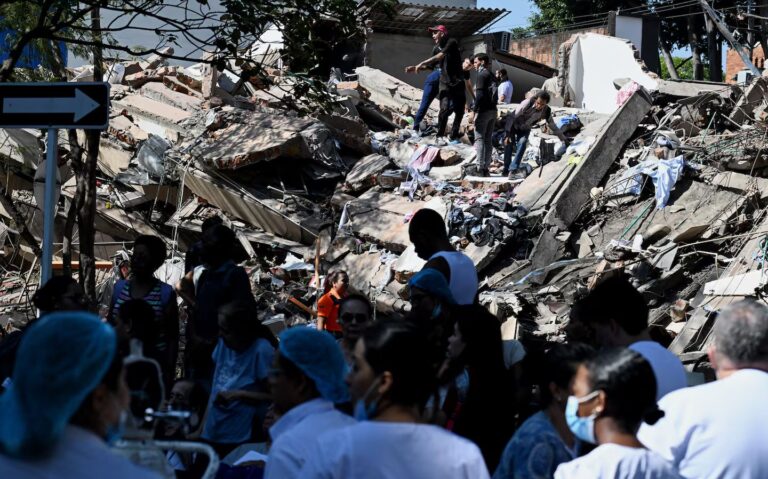
The death toll from the powerful 7.4-magnitude earthquake that struck Colombia on Monday has climbed to 132, prompting the government to declare a state of national disaster.
Authorities said the emergency declaration would enable the government to mobilise resources more quickly and provide assistance to communities worst affected by the disaster.
The Colombian Association of Capital Cities reported that five capital cities had been placed on red alert, while at least 86 buildings collapsed following the earthquake. Seven airports also suspended operations, disrupting transportation in affected areas.
Rescue teams are continuing efforts to search through collapsed structures, with officials putting the number of injured at about 570.
President Abelardo de la Espriella said the government had deployed all available resources to protect lives and provide relief to victims.
He said rescuing people trapped beneath the rubble remained the government’s immediate priority, while assistance would be delivered to communities in need.
Fierro Morales, director of the Colombian Geological Service, described the earthquake as the strongest to hit the country in the past decade. He said two aftershocks measuring 2.8 and 4.8 had so far been recorded, with the stronger one felt across a wide area.
According to Mr Morales, Colombia has a history of major earthquakes, citing the 7.2-magnitude earthquake that struck the country on November 23, 1979, as one of the notable previous events.
Meanwhile, the United States has announced $15.5 million in assistance for Colombia. The funding will support the provision of shelter, food and protection for people affected by the earthquake.
The U.S. Department of State said Washington was standing with the Colombian people and was prepared to work with President de la Espriella’s administration as authorities assess the humanitarian needs arising from the disaster.