
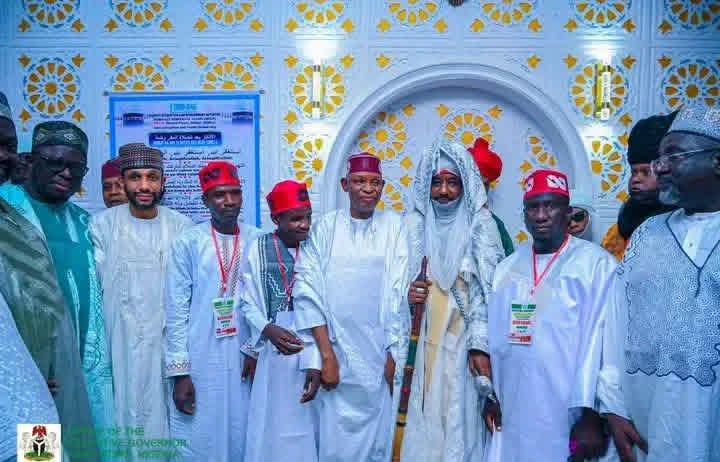
When Haruna Bashir walked into the Kano Central Mosque on Aug. 7, there was little to suggest that the man had endured one of the most painful experiences imaginable. He smiled, interacted with people around him and participated in the ceremony that marked the beginning of another chapter in his life.
Months earlier, Bashir had lost his wife and six children in a violent attack at Doroyi Quarters, Kano metropolis, while he was away trying to earn a living. Since then, people close to him said he had become withdrawn and preferred to stay alone.
For Bashir, his appearance was not just about getting married. “It was also an opportunity to reconnect with people after months of isolation following the loss of his family.”
He was there to marry Rahinatu Jamilu-Yunusa under the Kano State Government’s 2026 mass wedding programme, popularly known as “Auren Gata”. The programme brought together 1,500 couples whose marriages were sponsored by the state government.
At the ceremony, Gov. Abba Yusuf stood as Bashir’s guardian, while the Emir of Kano, Alhaji Muhammadu Sanusi II, stood for the bride.
The Commander-General of the Kano State Hisbah Board, Sheikh Aminu Ibrahim-Daurawa, said Bashir was taken as an example “because of the tragedy that had befallen him.”
“The governor sponsored Hajj and lesser Hajj for him, and gave him another house at Amana City, Kano,” Daurawa said.
“Ever since the pathetic incident, Bashir doesn’t like talking to people, but with this programme, he is now bouncing back to normal life.
‘You can see him now smiling and relating with others throughout the programme,’” he added.
Bashir’s ordeal began early in 2026 when assailants broke into his residence and killed his wife and six biological children. Following the incident, Yusuf visited him to condole with him and directed security agencies to pursue those responsible. A few days later, the governor sponsored him to perform Lesser Hajj in Saudi Arabia, and later Hajj.
*N1.5bn Support Package*
The state government says the programme is aimed at helping couples establish homes while reducing financial burden. Gov. Yusuf said the state spent N1.5 billion on the initiative.
“We provided N100,000 as dowry, in addition to another N100,000 as capital grant to serve as seed capital for starting a business and promote self reliance,” the governor said.
He added: “We also provided household furniture and essential items, including beds, mattresses, blankets among others, to enable the couples begin their married lives comfortably.
‘The government also provided food items and other essentials commodities to cushion the hardship they may encounter during the early days of their marriage,’” he said.
Medical screening was also conducted “to safeguard their health and that of their future children.”
*Orientation and Counsel*
The programme included an orientation course. Islamic scholars and professionals spoke on responsibilities, communication and conflict resolution.
Sheikh Aliyu Abubakar spoke on “The Wisdom of Marriage in Islam”, while Prof. Ibrahim Mu’azzam Mai Bushira addressed the rights and responsibilities of spouses. Sheikh Muhammad Nur Arzai spoke on causes of marital conflicts.
Representing the governor, Sheikh Ibrahim-Daurawa urged the couples “to regard marriage as a responsibility founded on compassion and mutual understanding.”
“Always strive to resolve disagreements through dialogue and respect, noting that these virtues are essential for building stable families and a peaceful society,” he said.
“Family stability remains a critical pillar for the development of any community,” he added.
Earlier, the Emir of Kano, Alhaji Muhammadu Sanusi II, “urged the couples to build their homes on faith, patience, mutual respect and compassion. He said peaceful families remained the foundation of a stable and prosperous society.”
*Mixed Reactions, New Beginnings*
For beneficiaries, the support was significant. Sa’adu Musa from Gezawa Local Government Area said: “I am excited like the way someone is excited on the day of Arafah.”
“Various scholars have counselled us that marriage is an act of ibadah (worship),” he said.
Usman Ibrahim from Kano Municipal added: “It is a joy and happiness for we the beneficiaries and the governor who sponsored the wedding.
‘I can’t quantify my joy. We commend the governor for his intervention,’” he said.
The Chairman of the North-West Governors’ Forum and Katsina State Governor, Dikko Radda, commended Yusuf, saying the initiative “would contribute to improving the living conditions of people in Kano.”
Islamic scholar Sheikh Kabir Gombe said the programme “could also contribute to addressing insecurity and social vices, particularly among young people.”
The reception held at the Kano Government House on Saturday brought the couples together again, with household items distributed.
*Beyond the Ceremony*
The programme has also generated debate on whether public funds for mass weddings could have greater impact in education, healthcare or employment.
But for the government, the approach combines “economic support, medical screening and premarital orientation.” For beneficiaries, the immediate assistance matters.
For Bashir, the journey is personal. A new marriage cannot replace the family he lost. But on Aug. 7, after months of isolation, he was seen smiling again.
“In a programme involving 1,500 couples and N1.5 billion in public expenditure, his story provides a reminder that behind the statistics are individuals carrying different experiences, hopes and expectations.
For him, Aug. 7 was a new beginning. For the other couples, it was the beginning of marriage. For the government, the real measure of the programme may ultimately lie in whether the support provided can help these couples build homes that remain stable long after the wedding celebrations are over.”