
By Emmanuel Awari -Jalingo
Governor, Dr. Agbu Kefas has disclosed that nature has given Taraba almost everything required to become one of the great agricultural centres of Nigeria.
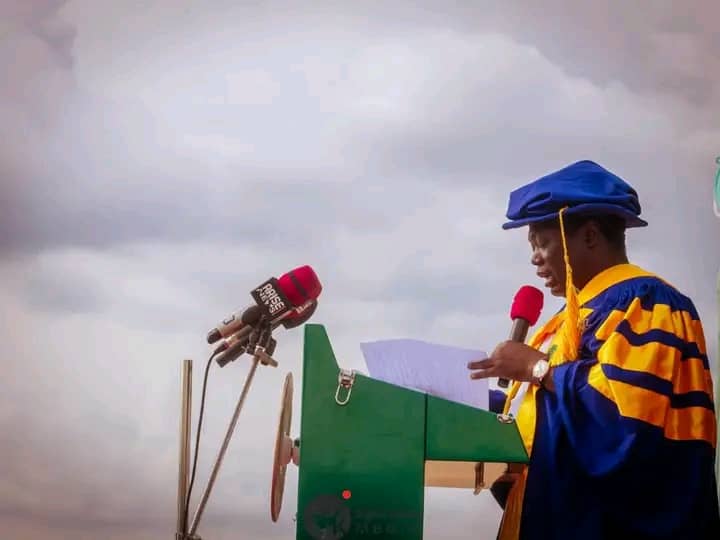
The Governor represented by the Speaker of the Taraba State House of Assembly, Rt. Hon. Kizito Bonzena, made the disclosure during the College of Agriculture, Science and Technology, Jalingo (COAST) for the 17th & 45th Combined Convocation Ceremony.
“We have forests.
We have communities with generations of agricultural knowledge. From the plains to the highlands, from rice to maize, tea, coffee, sesame, livestock, fisheries, fruits, and vegetables,
“Our challenge, therefore, is not the absence of resources. Our challenge is converting resources into prosperity.
“My dear graduands, your certificate is important, but what you do with it is even more important.
The world you are entering is changing rapidly.
“Agriculture is no longer simply about the hoe, the cutlass, and subsistence farming.
Modern agriculture is science.
It is technology, It is business, it is logistics, it is processing, it is climate intelligence, t is biotechnology, it is mechanisation,
It is export, and increasingly wealth.
“Taraba State is richly blessed.
We have vast fertile land.
We have abundant water resources.
We have diverse climatic conditions. We have livestock”, he said.
According to him, the present administration believes that the next revolution in Taraba State must take place on farms, in our processing centres, in our laboratories, and in our agricultural markets.
“We must move from farming for survival to farming for prosperity.
We must move from selling raw produce to processing and adding value. We must move from agriculture being treated as the occupation of the poor to agriculture becoming the enterprise of ambitious young people,” the governor said.
He said that institutions such as the College of Agriculture, Jalingo, must be at the centre of that transformation, adding that the College must not merely produce graduates who know agriculture.
It must produce young men and women who can transform agriculture.
“We want graduates who can establish commercial farms.
Graduates who can manage livestock enterprises.
Graduates who can develop improved seedlings.
Graduates who understand irrigation and climate-smart agriculture.
“Graduates who can build agro-processing businesses.
Graduates who can use drones, data, and modern technology to improve productivity. Graduates who will see one hectare of land not merely as soil, but as an economic opportunity.
“To the management and staff of this College, therefore, the challenge before you is clear. The classroom must increasingly connect with the farm.
Research must connect with the marketplace. Training must connect with entrepreneurship.”
He pointed out that the present administration will continue to place agriculture at the heart of the economic development of Taraba State.
“But government cannot do it alone. We need our universities.
We need our colleges. We need the private sector. We need financial institutions. We need traditional institutions. We need our communities. Most importantly, we need our young people.
“To the graduating students, I therefore want to say something very clearly that, Do not leave this College believing that success begins only when government gives you employment.
“Government employment is honourable, but it cannot be the only destination of education.
Some of you must become employers. Some of you must become commercial farmers.
Some must become agricultural consultants. Some must become processors. Some must become innovators. Some must become exporters. And some of you must build companies that will employ hundreds of other young people in the years ahead. That is the Taraba we are working to build”, he added.
He disclose that the present administration is purse to build Taraba where opportunity is not limited to government offices.
“A Taraba where a young graduate can look at agriculture and see a future. A Taraba where our raw materials are processed within our State. A Taraba where our farmers become wealth creators. A Taraba that feeds itself, feeds Nigeria and eventually competes in international markets.
“My dear graduands, the future will not simply belong to those who have certificates.It will belong to those who can solve problems.
Where others see waste, see opportunity.
“Where others see uncultivated land, see production. Where others see unemployment, create an enterprise. Where others see challenges, apply the knowledge you have acquired here.
“Let your generation prove that agriculture can be sophisticated, profitable and dignified. Let your generation prove that the greatest opportunities in Nigeria may not necessarily be found beneath our feet as minerals, but also in the soil we cultivate and the value we create from it,” the governor said.
He congratulated parents and guardians whose sacrifices made the day possible.
He also congratulated the Governing Council, Management and staff of the College for nurturing the young men and women, adding that Taraba State expects them to leave with something greater in their heart and determination to create value.
“Go out and cultivate ideas.
Cultivate enterprises.
Cultivate innovation.
Cultivate prosperity.
And as you cultivate the land, may you also help us cultivate a new future for Taraba State,” he stated.
Speaking, the Rector of the College, Dr. Yakubu Ali Garjila, expressed appreciation to the governor for interventions that contributed to the successful re-accreditation of programmes offered by the institution.
He, however, identified inadequate hostel facilities, offices and staff accommodation, electricity supply and poor road conditions as some of the challenges affecting the College.
The Rector appealed for continued support to address the challenges and provide a more conducive environment for teaching, learning and research.
Speaking on behalf of the graduands, the Valedictorian, Donald Daniel, commended Governor Kefas for his interventions in the education sector and his support for the College.
He urged his fellow graduands to put their education to practical use and contribute meaningfully to the development of their communities.