
From Bridget C. Onochie and Sandra Chukwugekwu
The effects of climate change are increasingly felt across West African countries. These are not limited to environmental degradation but also extend to humanitarian crises, including struggle for land, poor access to potable water, insecurity as well as harsh economic situations.
As rainfall patterns continually change, water becoming scarcer and productive land under growing pressure, communities that depend on farming and livestock for survival are forced to adapt. Unfortunately, forceful adaptation is becoming increasingly difficult with glaring consequences in farmer-herder conflicts, population displacement and growing poverty.
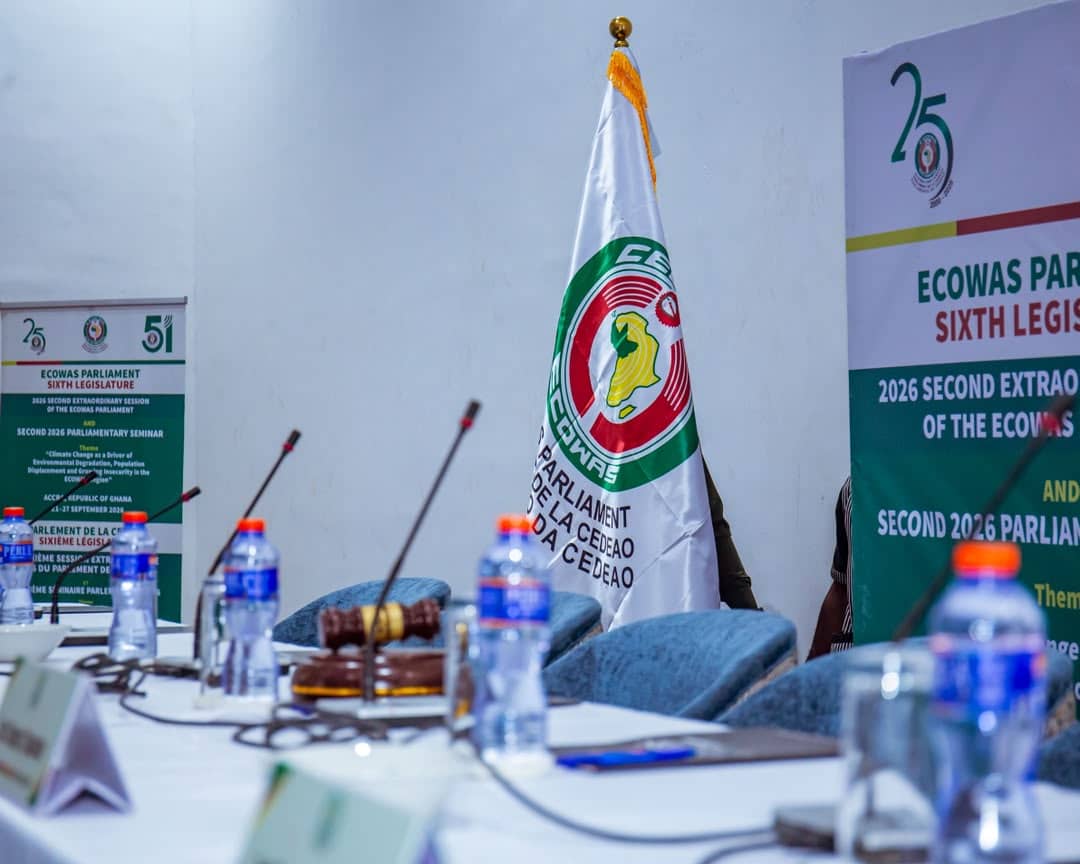
This formed the thrust of deliberations at the Second 2026 Parliamentary Seminar of the Economic Community of West African States, ECOWAS, in Accra, Ghana.
The seminar, which opened earlier in the week, examined climate change as a driver of environmental degradation, population displacement and rising insecurity across the region.
*From Environmental Pressure To Human Displacement*
Nigeria’s presentation highlighted the complex nexus between change in environment, competition for resources, conflict and displacement.
The report held that although the country has a large agricultural and pastoral population, there is increasing pressure on land and water propelled by population growth, agricultural expansion, climate variability, environmental degradation and changing migration patterns.
These pressures, the report indicated, have contributed largely to lingering tension between farmers and pastoralists in virtually every state.
The presentation noted that disputes emanated from crop destruction, competition over land and water, encroachment on livestock routes, cattle theft and changing patterns of seasonal migration.
The report however stressed that farmer-herder conflict cannot simply be understood as dispute between two groups but that instigated by communal tensions, banditry, organised crime, climate pressures and weaknesses in mechanisms for resolving disputes.
“In Nigeria, internal displacement has been linked to armed conflict, communal violence, farmer-herder conflict, banditry, terrorism, flooding and other disasters,” the report stated.
The country’s presentation cited International Organization for Migration figures showing more than 2.2 million internally displaced people in the North-East and more than 1.3 million in the North-Central and North-West regions based on 2025 assessments.
It described displacement as more than humanitarian concern but also that of development, governance, security, environmental and economic issue.
On farmer-herder problem, the report held that for communities that depend on agriculture and livestock, access to land and water is not simply economic question but that of survival.
*Togo, Gambia Offer Lessons*
Similarly, report from Togo read that authorities have developed a national framework for managing transhumance and preventing conflicts associated with movement of livestock.
The country’s presentation acknowledged that while transhumance remains important to pastoral communities, tensions can emerge when natural resources are degraded, farmland expands or livestock damages crops.
Togo was said to have established a National Transhumance Committee in 1995 to monitor livestock movement, routes, animal health and disputes but changing security and environmental situation prompted country to adopt new 2026–2030 plan.
The plan identifies farmer-herder conflict, pressure on land, climate change, security crises, inadequate monitoring and weak enforcement among challenges affecting transhumance management.
Yet, underlying problem is increasingly clear – when traditional routes become inaccessible, water sources diminish or agricultural land expands, competition cannot but intensify. Also, where mechanisms for dialogue and dispute resolution are weak, environmental pressure can become security problem.
The Gambia’s experience provided another dimension. Through the Participatory Integrated Platform for Resilience and Food Security, P2P2RS Phase II, the country supports communities to improve food security while strengthening ability to cope with climate-related risks.
The project according to report, focuses on sustainable agriculture, natural-resource management, climate adaptation and rural livelihoods. It targets small-scale producers, herders and agro pastoralists across 19 districts. Its interventions include climate-smart agriculture, irrigation, agricultural inputs, livestock support, post-harvest equipment and assistance for women and young people.
“The programme has also included sensitisation on farmer-herder conflicts, including discussions around cattle tracks and grazing areas. The approach reflects a broader lesson emerging from the regional discussion – that climate resilience cannot be treated only as an environmental issue but must also address food production, livelihoods, poverty, natural-resource management and social stability,” the report noted.
The Gambia’s presentation described climate resilience as most effective when agricultural productivity, environmental protection, nutrition and livelihoods are addressed together. It also identified women and young people as important groups in building resilience.
*Water Scarcity And Survival*
However, challenge is more pronounced in countries facing severe water constraints. Consequently, Cabo Verde’s presentation focused on implications of climate change and water scarcity on sustainable development.
The country in its report said it is pursuing measures to protect and increase water availability, strengthen coastal protection and improve management of water resources. Its adaptation priorities include integrated water management and climate-adapted agricultural production.
“The experience demonstrates how climate change can affect the basic foundations of economic and social life. For instance, water scarcity affects agriculture, agricultural pressure affects livelihoods and livelihood pressures influence migration,” Cabo Verde stated.
It held further that where migration intersects with competition over scarce resources, tensions increase.
*Beyond Emergency Relief*
Beyond emergency relief, reports held that for people forced from their homes, challenge does not end when they receive food, shelter or emergency assistance.
Nigeria’s presentation for instance, argued that durable solutions require conditions that allow displaced people to rebuild their lives. These include safe and voluntary return, local integration or relocation, access to land and housing, restoration of property rights, livelihoods, education, healthcare, documentation and participation in community life.
Consequently, emphases are shifting from simply responding to displacement to preventing conditions that produce it, implying necessity for investing in early-warning systems, conflict prevention, mediation, land and resource governance, climate adaptation and sustainable livelihoods. It also means improving livestock infrastructure and addressing disputes before they escalate.
Nigeria’s presentation also argued that security operations alone cannot resolve underlying problems. Rather, communities require platforms for dialogue, effective institutions and economic opportunities.
The role of parliament, according to report therefore include, placing particular emphasis on role of legislators in influencing policies, laws and budgets needed to address climate-related displacement and insecurity.
The Gambia in its report, canvassed climate resilience and food security receiving greater attention in legislative agendas, budgets and oversight.
Nigeria similarly highlighted need for evidence-based parliamentary oversight, stronger legislative frameworks and platforms for dialogue involving displaced people, farmers, pastoralists, women, young people and host communities.
This no doubt, positions parliamentarians at intersection of environmental policy, security, development and human rights. The report equally admonished that lawmakers should not simply respond after displacement has occurred but should rather help in creating policies that reduce likelihood of conflict while strengthening communities’ capacity to withstand climate shocks.
General, the fact that resonated in reports is that regional problem requires regional response, especially as climate-related displacement does not follow national boundaries, pastoralists move across borders and weather systems transcend borders.
The reports also pointed to fact that conflicts can trigger migration and instability in one community having consequences beyond its immediate location, a situation that makes regional cooperation increasingly important.
The presentations therefore called for stronger knowledge-sharing, community participation, early-warning systems, climate adaptation, resource governance and parliamentary cooperation.
The report also buttressed that climate change cannot be addressed without considering livelihoods and issue of displacement cannot be addressed without considering peace and security. Also, farmer-herder conflict cannot be separated from questions of land, water and livestock management.
For West Africa therefore, task is to ensure that environmental change does not continue to translate into loss of livelihoods, conflicts and forced movement.
The reports suggested measures to prevent displacement through better planning, stronger institutions, climate adaptation, resource management and investment in communities vulnerable to changing environment.