
By Aaron Mike Odeh
Kwara State has taken another significant step towards expanding reliable and sustainable electricity access with the commissioning of a 581kWp interconnected solar mini-grid at Oke-Oyi Community in Ilorin East Local Government Area, further underscoring the growing impact of the Rural Electrification Agency (REA) under the leadership of its Managing Director and Chief Executive Officer, Dr Abba Abubakar Aliyu.
Commissioned on Thursday, September 24, 2026, by the Federal Government through the Rural Electrification Agency, the project was delivered under the Rural Electrification Fund–Interconnected Mini-Grid Acceleration Scheme (REF-IMAS). Developed by Nayo Tropical Technologies Limited with support from the German Government and the European Union through GIZ, the project comprises 1,336 solar panels, 84 batteries and approximately 10 kilometres of distribution cables and transformers.
The Oke-Oyi intervention represents more than an electricity infrastructure project. It is a practical demonstration of how strategic renewable-energy investment can support local enterprise, stimulate economic activity and improve livelihoods.
Already, the impact is being felt across the community. Reports from the commissioning indicate that the project has supported 12 welding businesses, two sachet-water companies, four grain mills, four aluminium enterprises, an ice-block production business and a cold-room/ice-fish depot. Three electricity vendors are already operating, with additional vendors, including a female-owned enterprise, expected to join the emerging electricity market.
For Dr Abba Abubakar Aliyu, the development reflects a leadership philosophy that places measurable outcomes at the centre of public-sector intervention.
His technocratic and pragmatic approach to rural electrification is increasingly evident in the way REA projects are being positioned not simply as power infrastructure, but as platforms for enterprise development, employment, education, water access and improved economic productivity.
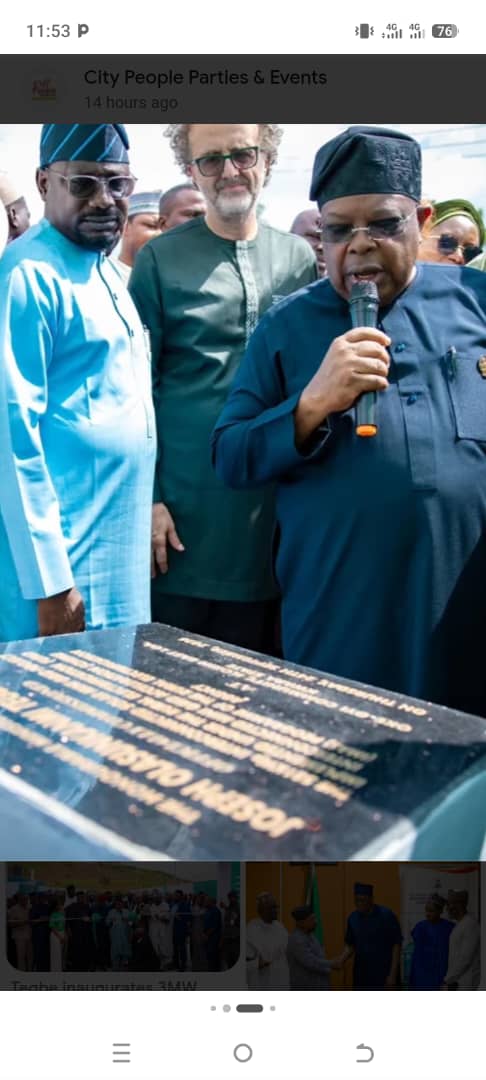
Speaking at the commissioning, the Minister of Power, Joseph Olasunkanmi Tegbe, reinforced the importance of linking electricity access to productive economic activity. The objective, he noted, is ultimately to improve lives and create opportunities.
That philosophy is particularly visible in Oke-Oyi, where reliable electricity is already helping businesses that depend heavily on power to operate more efficiently.
A welder requires electricity to run equipment. A grain mill depends on consistent power to process agricultural produce. Cold-room operators need dependable electricity to preserve food products. Water producers require power for production and distribution. In each case, electricity becomes an economic input rather than merely a household convenience.
Dr Aliyu has consistently emphasised this broader understanding of electrification: that the real value of infrastructure should be measured by the opportunities and productive activities it enables.
Oke-Oyi therefore provides another practical expression of the REA’s evolving approach under his leadership.
The development also forms part of a wider pattern of interventions being implemented across the country.
In June 2026, REA commissioned a 505kWp interconnected solar mini-grid serving five communities in Epe Local Government Area of Lagos State—Odogbawojo, Odoshiwola, Odoayan, Ora and Ibowon. The project was designed to serve households, small businesses, public institutions and productive users, while promoting private-sector participation in sustainable electricity delivery.
Earlier, in Damau, Kubau Local Government Area of Kaduna State, REA delivered a 100kWp solar mini-grid serving more than 2,500 residents. Significantly, the intervention also powered a solar submersible borehole, demonstrating how renewable energy can simultaneously address electricity and potable-water challenges.
The Agency’s intervention in education has equally assumed strategic importance.
On September 16, 2026, the Federal Government commissioned a 3MW solar hybrid power project at Yakubu Gowon University, Abuja, under Phase II of the Energizing Education Programme. Delivered by REA through the World Bank-funded Nigeria Electrification Project, the project is designed to strengthen electricity supply for teaching, research, laboratories, digital services, campus lighting and other critical university operations.
Yakubu Gowon University has almost 40,000 students, more than 8,000 resident students and over 3,500 staff. REA says the wider Energizing Education Programme has delivered renewable-energy infrastructure to 22 federal universities and three affiliated teaching hospitals, deploying more than 100MW of clean energy and impacting over 600,000 students and 50,000 academic and administrative staff nationwide.
These interventions demonstrate a developing model of public-sector leadership in which electricity is treated as an enabler of wider national development.
From rural communities to universities, the emphasis is increasingly on what electricity makes possible: businesses that can expand, students who can study in better conditions, health and social services that can operate more reliably, entrepreneurs who can invest and communities that can build stronger local economies.
For Kwara State, the Oke-Oyi project represents another important milestone in that journey.
Its success, however, will ultimately depend on sustainability. Government institutions, communities, developers, utilities and electricity users must collectively protect the infrastructure, support maintenance and ensure that the economic benefits generated by the project continue to expand.
The Oke-Oyi experience has already demonstrated the potential.
Under Dr Abba Abubakar Aliyu’s technocratic and pragmatic leadership at REA, the conversation around rural electrification is increasingly moving beyond the question of whether electricity has been provided to a more consequential question: what can communities achieve when reliable electricity becomes available?
In Oke-Oyi, the answer is beginning to emerge through businesses, productive activities, employment opportunities and improved prospects for local economic advancement.
The commissioning of the 581kWp solar mini-grid therefore marks more than the switching on of another renewable-energy facility. It represents another step towards a development model in which sustainable electricity becomes a foundation for enterprise, human capacity and community prosperity.
Aaron Mike Odeh
A Public Affairs Analyst, Media Consultant, Human Capacities Building and Community Development Advocate, wrote from Post Army Housing Estate, Kurudu, Abuja