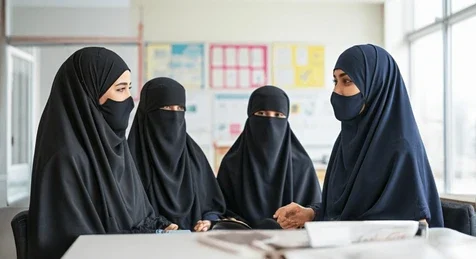
The Italian government on Thursday said it has approved a ban on the burqa and niqab in schools, with a limit on the share of pupils who speak little Italian in any one class.
Prime Minister Giorgia Meloni said the measures are “common-sense tools that do not divide but really help to integrate”.
Opposition parties accused the government of adopting policies favoured by the hard-right Futuro Nazionale party ahead of next year’s general election.
The minister of education, Giuseppe Valditara, said the limit is “purely linguistic” rather than a matter of citizenship.
Mr Valditara also sought to frame the ban on the niqab and burqa as a matter of gender equality.
“You must go to school with your face uncovered,” Ms Meloni said while announcing the plan on Sunday.
She said that a young woman should not hide herself in the name of tradition.
However, the proposed veil ban would apply to the burqa and niqab, but not the hijab.
In primary schools, the ban would apply to non-Italian citizens who were either not born in Italy or had not attended at least two years of nursery school.
In lower and upper secondary schools, it would apply to pupils without Italian citizenship who had not completed at least three years in the Italian school system.
The education minister said the measure was aimed at preventing the creation of “ghetto classes.”