
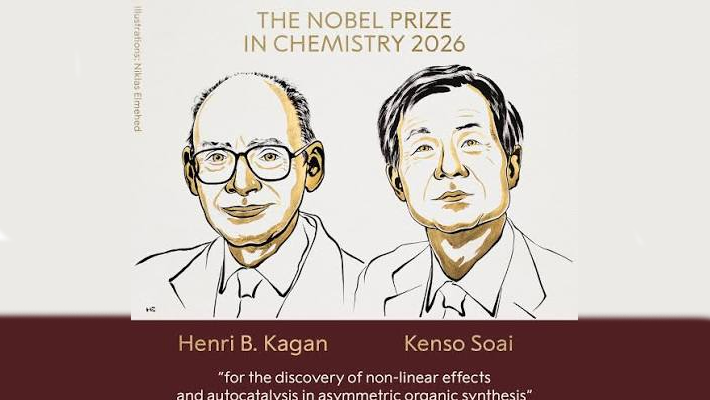
The Royal Swedish Academy of Sciences has awarded the Nobel Prize in Chemistry 2026 to Henri B. Kagan and Kenso Soai.
The duo were awarded “for the discovery of non-linear effects and autocatalysis in asymmetric organic synthesis.”
Messrs Kagan and Soai solved the puzzle of chemical asymmetry in living organisms.
“Henri Kagan discovered a new way of manipulating chemical reactions, allowing a greater excess of one of the mirror images to be created than was previously assumed possible,” the Academy stated.
“His discovery has been revolutionary for chemists who develop reactions for the manufacture of pharmaceuticals, flavours, scents and new materials.”
Mr Kagan, 85, is an emeritus professor at the Université Paris-Saclay in France and pioneer of asymmetric catalysis.
“Kenso Soai designed the first chemical reaction in which only one of the potential mirror images was formed. Other than life itself, no one had ever achieved this feat,” said the Royal Swedish Academy of Sciences on Wednesday.
Mr Soai, 76, is a Japanese organic chemist and emeritus professor at the Tokyo University of Science.
“Some molecules, such as amino acids, exist as two variants that are each other’s mirror image. However, living organisms only contain one of these mirror images. How chemical asymmetry such as this could have emerged was long a mystery to chemists,” the Academy said.
“Henri B. Kagan and Kenso Soai have been awarded the Nobel Prize in Chemistry 2026 for discovering a solution to this puzzle.”