
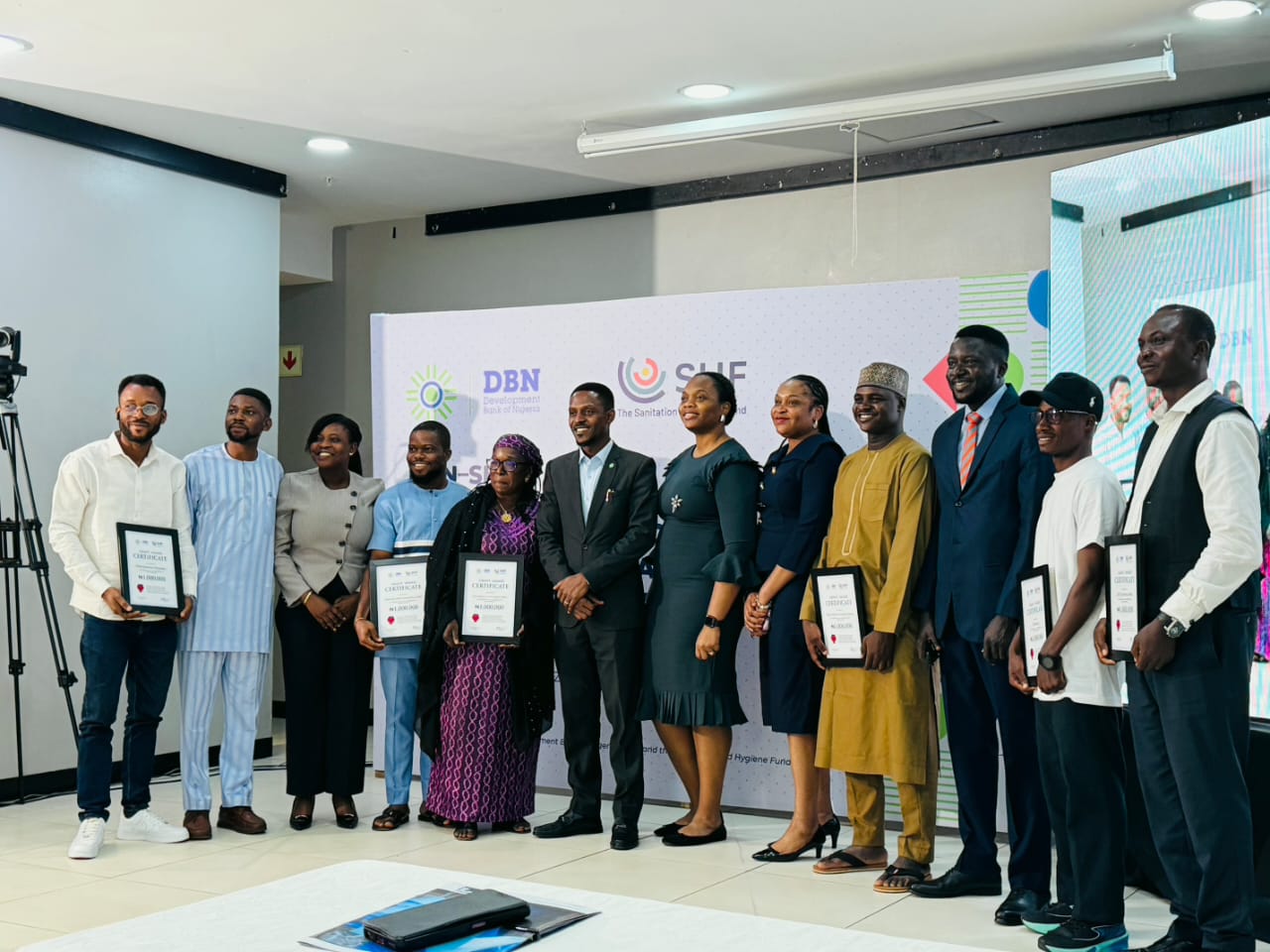
Sanitation and menstrual health businesses in Nigeria are struggling to access credit, operators have said, as the Development Bank of Nigeria (DBN) and LoftyInc Allied Partners Limited awarded grants of up to N1 million each to 24 enterprises in the sector.
The grants were announced at the close of a capacity building programme in Abuja on Thursday, aimed at preparing sanitation businesses to access financing and improve their operations.
MaryEsther Ezeadi, Head of Credit Operations and Collections at DBN, said the grants were intended to support business expansion, asset acquisition, digital tools, technology adoption and service delivery.
She said four micro, small and medium enterprises (MSMEs) from each region were selected for the grants.
“The purpose of the grants is not to fund personal expenditure or acquire additional property. They are intended to support business improvements,” she said.
Ezeadi said more than 11 participating financial institutions had developed sanitation financing products through the programme, which was designed to prepare both businesses and lenders to participate in the sector.
Femi Oluwagbemi, Growth Partner at LoftyInc Allied Partners Limited, said the programme, tagged “From Diagnostics to Bankable Enterprises”, was designed to help sanitation businesses meet lenders’ requirements.
“In many cases, lenders do not fully understand the needs of these specialised enterprises, the challenges they face or the complexities of their businesses,” he said.
Oluwagbemi said more than 1,000 enterprises applied to participate in the programme, while more than 30 were matched with lenders for financing discussions.
He said the programme trained businesses on financial record keeping, credit requirements, business models and loan readiness, while participating financial institutions worked on products for the water, sanitation and hygiene sector.
Chukwuma Nnanna, Executive Director of Toilet Pride, said businesses in the sanitation sector struggled to obtain loans because lenders often did not understand their operations.
“The biggest challenge has been creating the enabling environment where small businesses can thrive, can stay sustainable,” he said.
Nnanna said some businesses closed within three years because they could not secure the financing needed to sustain their operations. He called for greater institutional support and private sector investment in the sector.
Monica Tanko, Chief Executive Officer of Arewa Women and Youth Development Initiative (AWOYDI), said inadequate funding limited her organisation’s efforts to expand menstrual hygiene services and provide sanitary pads to women and girls.
Tanko said her organisation distributed reusable sanitary pads and worked with 20 girls as sales agents in their communities. It is targeting 5,000 women in 2026.
She said the programme’s training had also helped her organisation improve its record keeping and monitor its other business operations.
“Before the training, record keeping was an issue for us,” she said.
Tanko said the organisation reviewed its pure water business after the training and began monitoring its operations more closely.
“Before we used to have like N100,000 in a week. But with this constant training that we pay more attention, they’re giving us N180,000 in a week,” she said.
She said the organisation was also exploring ways to make reusable sanitary pads more affordable by selling them in smaller quantities.
Tanko said access to funds to purchase sanitary pads and support community level workers remained a challenge.