
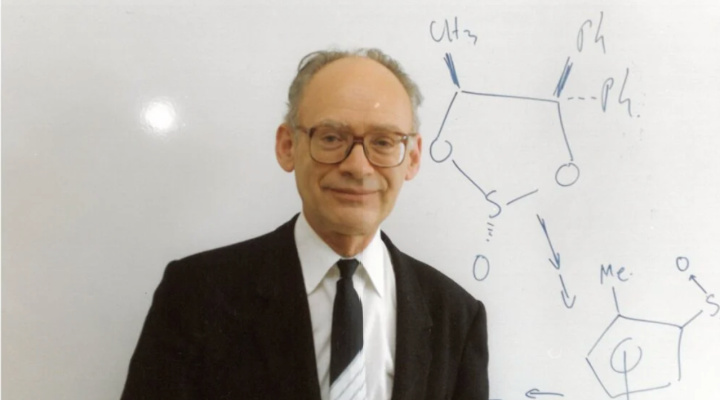
French chemist and Holocaust survivor Henri B. Kagan has won the 2026 Nobel Prize in Chemistry alongside Japanese scientist Kenso Soai for discoveries that have helped advance chemical synthesis and pharmaceutical manufacturing.
Kagan, 95, and Soai were recognised for their work on non-linear effects and autocatalysis in asymmetric organic synthesis, research that has helped scientists understand how chemical reactions can produce molecules with a consistent handedness, a phenomenon known as homochirality.
The Royal Swedish Academy of Sciences, which selects Nobel laureates, said the discoveries, made during the 1980s and 1990s, enabled chemists to control reactions that lead to homochirality.
The two scientists will share the prize money of 12 million Swedish kronor equally.
Heiner Linke, chair of the Nobel Committee for Chemistry, said the researchers had resolved a scientific puzzle that had challenged chemists for more than a century: how homochirality could emerge spontaneously.
Kagan’s achievement has attracted recognition in France, with the French Academy of Sciences, of which he is a member, congratulating him on the award.
French President Emmanuel Macron also praised the scientist, describing the Nobel Prize as a source of immense national pride and a fitting recognition of his lifetime of research.
Born in December 1930 in Boulogne-Billancourt, France, Kagan survived the Holocaust after his family escaped Nazi persecution by hiding in a village in southern France under assumed identities, according to the World Jewish Congress.
He obtained his doctorate from the Collège de France in 1960 and later became professor emeritus at Université Paris-Sud, now part of Université Paris-Saclay.
The Nobel Prize is not Kagan’s first major international recognition. In 2001, he received the Wolf Prize in Chemistry alongside Japanese chemist Ryoji Noyori and American chemist K. Barry Sharpless.