
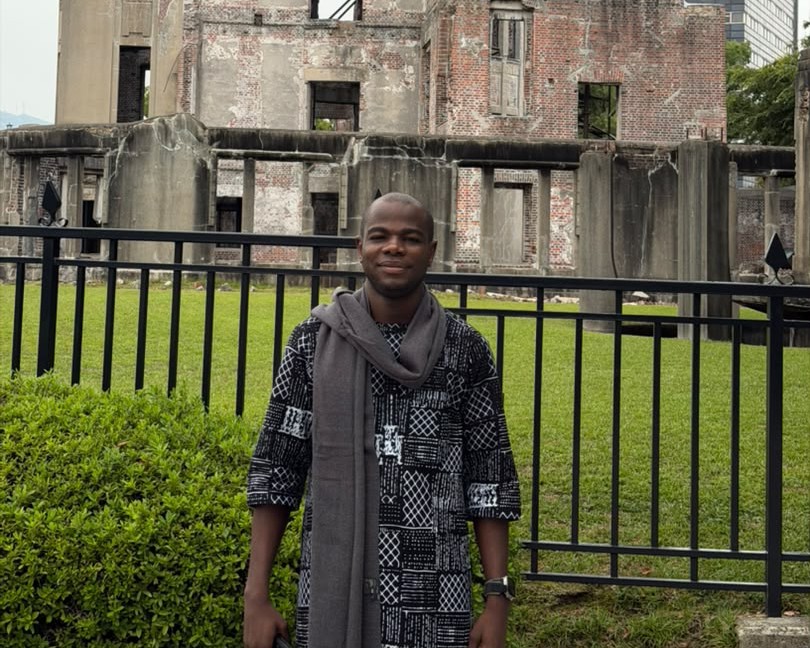
By Mahmud Muhammad
Standing in Hiroshima today left me truly speechless. I have visited many places in the course of my academic and professional life, from bustling capitals to quiet rural communities recovering from crisis, but standing in the Hiroshima Peace Memorial Park this afternoon is an experience that sits quietly in my heart long after I walk away.
I am here in Japan with the Japan International Cooperation Agency (JICA) as part of a program on state resilience, post-disaster recovery, and public governance. For weeks, we have been dissecting frameworks, resilience indices, reconstruction models, and governance structures that help societies bounce back from catastrophe. On paper, Hiroshima is the ultimate case study. However, being here in person hits you on a completely different, deeply human level. No report can capture it.
The morning was cool and misty, the kind of weather that made the Motoyasu River look like glass. The park itself was immaculate—green, open, and serene. Students cycled past, elderly couples walked hand in hand, and tourists whispered. It was so deliberately peaceful that you almost forgot why it existed, until you saw it: the Genbaku Dome. The Atomic Bomb Dome was not imposing. It was not grand. It was a ruin, left exactly as it was after 8:15 a.m. on August 6, 1945.
The exposed steel ribs of its dome, the hollow windows, the crumbling brick—it stands in defiance of preservation. While the Americans wanted it demolished, the people of Hiroshima insisted it remain. Standing before it, I felt a deep, heavy silence fall around me, despite the crowd moving all around. It is the silence of 140,000 souls. It is the silence of a city that vanished in a flash of light brighter than the sun.
Walking slowly to the Peace Memorial Museum shatters the comfortable distance of history, transforming abstract dates of the August 6, 1945, atomic bombing into an overwhelming confrontation with human loss and enduring resilience that echoes in your heart long after you leave. Inside, the air is different. You don’t see history. You feel it.
They have chosen to tell the story not through numbers or military strategy, but through the ordinary: a child’s lunchbox—a small, blackened aluminum box with charred rice and peas still stuck inside. The owner, a first-year middle school student named Shigeru Orimen, never got to eat it. A wristwatch stopped at exactly 8:15. A little girl’s stained red dress. A tricycle that belonged to Shinichi Tetsutani, who was only three years old. He loved riding it; he died that night.
Looking at these simple personal belongings, like a child’s lunchbox or a burned watch, you don’t think about politics, stats, or policies anymore. The language of governance, collateral damage, strategic necessity, and casualties loses all meaning. You think about families. You think about a mother packing lunch. You think about human lives that were getting ready for an ordinary Monday. It makes you have to step outside for a moment.
But what moved me to my core wasn’t just the history of sorrow; it was the story of what happened next. This is where Hiroshima becomes a profound lesson for every leader, every public servant, and every Nigerian who has experienced loss. In 1945, experts predicted that nothing would grow there for 75 years—that the soil was poisoned and the city was dead. Yet, by 1946, red canna lilies bloomed defiantly through the ashes.
Taking that as a sign, the people of Hiroshima planted trees, rebuilt their homes, and cleared the rubble with their bare hands. They made a conscious, almost spiritual choice not to let bitterness define them. Refusing to build a city of revenge, they chose to build a city of peace. Instead of a memorial to anger, they created a global home for peace and hope—an act of leadership more profound than any policy document I have studied.
An elderly hibakusha—an atomic bomb survivor in his late eighties who volunteers as a storyteller in the park—spoke to our group. He was seven when the bomb fell, and he lost his sister. He looked at us and said with a calm smile, “We hated the bomb, not the people.” I wrote that down immediately.
Standing near the Children’s Peace Monument, surrounded by millions of colorful paper cranes sent by children from across the globe, I understood what he meant. The monument is dedicated to Sadako Sasaki, the 12-year-old girl who developed leukemia from radiation and believed that folding 1,000 paper cranes would grant her wish to live. She died having folded over 1,300.
Today, schools from Sokoto to São Paulo still send cranes here. I saw a fresh strand from Kenya just that morning. When I rang the Peace Bell—a large bell inscribed with a world map without borders—the sound did not just ring; it lingered. It traveled across the river and seemed to ask us all a question: What will you do with the peace you have?
As a PhD candidate in Public Governance and Leadership—and as a Nigerian who has witnessed communities struggling to recover from conflict and disaster—I am taking home lessons that no lecture could ever teach. Resilience is not built on infrastructure alone. It is rooted in identity.
Hiroshima rebuilt not just roads and houses, but a new identity for itself, transforming from victim to peacemaker. True resilience is demonstrated when a people decide who they want to become after a tragedy. Hope became a public policy. The city government made hope tangible. They preserved the Dome not to remember death, but to protect peace. They created spaces where the world must come and promise “never again.” Hope was institutionalised. Real strength lies not in how hard we fight, but in how deeply we care for each other and protect peace. This city forgave a world that had destroyed it, and in doing so, it gained moral authority over that same world.
Buildings can be replaced, but hope is what truly rebuilds a society. Hiroshima is living proof that no matter how deep the trial or how total the loss, a people united in hope—and guided by visionary, compassionate leadership—can always rise again. Not just to return to what they were, but to become even greater. I left a paper crane there. I folded it poorly, but I folded it with Nigeria in my heart. Arigato, Hiroshima. Thank you for teaching me.
Muhammad is a Ph.D candidate of Public Governance and Leadership, currently on a study programme in Japan with JICA.